
AI isn't taking your job. It's taking your evenings.
The first real AI labour signal isn't lost work; it's a day that never fully ends.

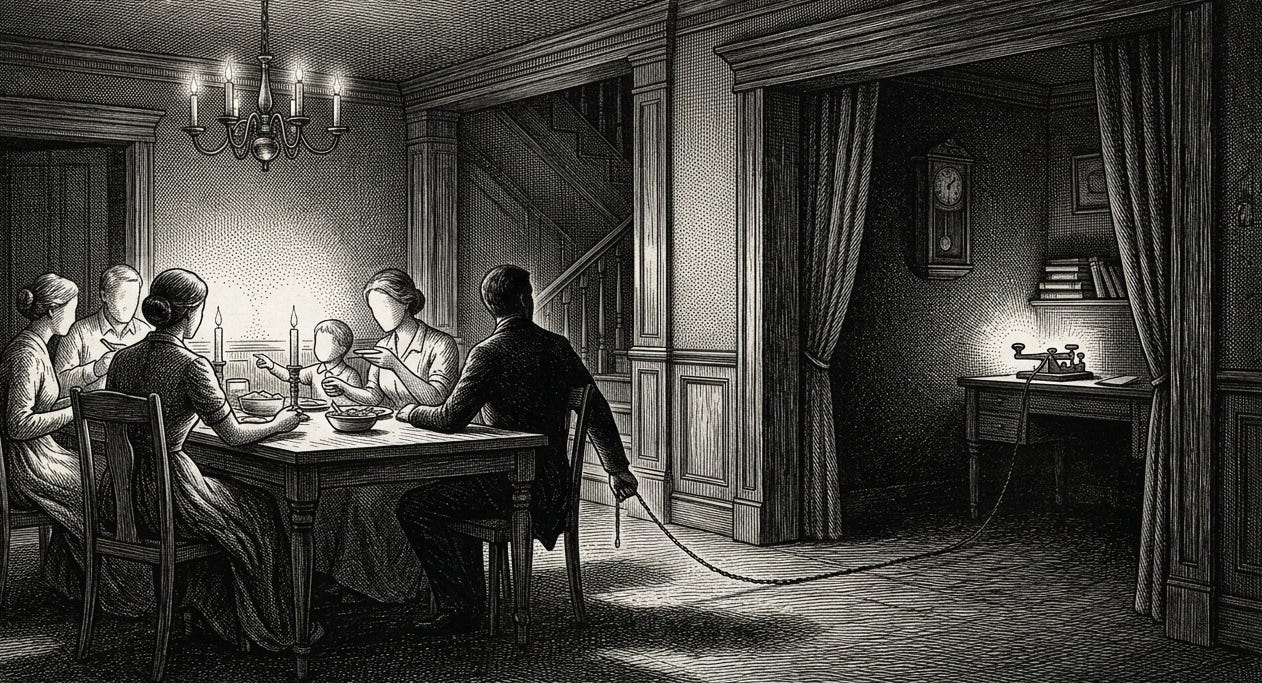
It’s 6:30 pm on a Wednesday. Elena, a consulting partner, has just closed her laptop. Dinner is on the table. Her phone buzzes. Not a Slack message. Not an email. It’s Claude, letting her know the draft proposal she queued at 4 pm is ready for review.
She tells herself it’ll take 30 seconds. It takes 12 minutes. Twelve minutes of re-reading, clarifying, re-queuing. By the time she looks up, the conversation at the table has moved on without her. She isn’t working late. She isn’t even doing what she’d call work. She’s just keeping a loop open that didn’t exist 18 months ago.
This is cadence creep. And if you’re a senior professional, you’re probably already living inside it.
I’m not describing this from the outside. A few months ago, I described a morning where I did more than I used to do in a week, and how my body paid for it by 8 pm. What I left out was how far it ran after that. I stopped riding my bike. I was using AI before work and again after dinner, and the loops never closed. I’d stay up later because the draft was almost done and the next clarification was one message away. Then I’d wake at 3 am and reach for the laptop to re-queue something that could have waited until morning. My Whoop was screaming at me, recovery in the red for days.
None of it felt like overwork. Every open loop was small, and that’s the danger. A loop small enough to keep is a loop you never close, and there is always one more. You can’t discipline your way out of that. What pulled me back was designing the cadence on purpose: deciding when a loop was allowed to stay open, and when it had to shut.
You feel it before you can name it
You can feel it before you can name it. More small check-ins. More asynchronous decisions that need a yes, a tweak, a redirection. More temptation to keep the loop open because the agent is still running, the draft is almost done, or the next clarification is one message away. The result isn’t necessarily more output. It’s often more fragmentation, more decision residue, and less confidence about where work should end.
Anthropic’s June 2026 Economic Index gives the clearest signal yet that this isn’t a personal discipline problem. It’s a structural shift in how professional time is organised.
The report tracks Claude usage across the week and finds something more interesting than raw productivity gains. It finds rhythm. Business correspondence peaks at 10–11 am. News requests spike at 7 am. Recipe queries rise at 6 pm. Sleep advice clusters before dawn. Personal-use share climbs from about 35% on weekdays to just under 50% on weekends. This is life-pattern use. AI is already bleeding across the line between work tooling and life tooling.
For senior professionals, the bleed is asymmetric. Off-hours work use skews toward higher-wage occupations. The people who delegate the most are also the ones most likely to feel their boundaries dissolve first. You save time on the task itself while still losing the day to constant monitoring, clarifying, approving, and re-entering partial loops.
The new work that doesn’t look like work
The obvious response is to call this a discipline issue. Better boundaries. Better habits. Better notification hygiene. But that framing misses the mechanism. The tool isn’t interrupting you. It’s creating a new kind of work that doesn’t look like work. A clarification isn’t a task. A review isn’t a meeting. A quick check-in isn’t logged anywhere. It just erodes the space between work and recovery until it’s gone.
You can’t time-block your way out of a tool that redefines what counts as work.
The better question to ask
Stop asking “How do I use AI more?” Instead, ask, “What cadence do I want AI to create around my work and life?”
This question changes how you design your operating system. It forces you to decide when AI should compress work, when it should defer work, and when it should stay out of the way so attention, recovery, and judgment don’t get quietly cannibalised.
Compress, defer, block out
Here’s a simple way to think about it.
Compress mode is for tasks that should be faster but shouldn’t expand to fill new time. Drafting, summarising, formatting, and first-pass analysis. The rule: queue it, close the tab, check it at your next natural work boundary. If you’re checking it at dinner, you aren’t compressing. You’re expanding.
Defer mode is for tasks that should wait. Deep research, complex synthesis, strategic scenarios. The rule: set a longer loop. Hours, not minutes. The goal is to protect your calendar from the illusion of progress that comes from rapid partial outputs.
Block-out mode is for recovery, judgment, and the kind of thinking that degrades when your inputs are fragmented. The rule: no agent access during these windows. Why? Because the quality of your judgment depends on contiguous attention, and contiguous attention is what cadence creep destroys first.
What cadence creep really costs
Your edge has always been judgement. Not output volume. Not task completion. The ability to see the whole board, make decisions under uncertainty, and allocate energy where it matters. Cadence creep doesn’t replace that judgment. It quietly degrades it by fragmenting the conditions that produce it.
Anthropic’s data also contains another signal. Heavier delegators report more optimism about labour-market outcomes, not less. That doesn’t mean AI is guaranteed to improve wellbeing. It means the people who are learning to delegate well are experiencing the shift differently than the people who are just being shifted. The variable isn’t the tool. It’s the design.
Design the cadence, or it will design you
So the operating rule is this: don’t delegate tasks without also designing the cadence. Every time you hand something to an agent, ask when you expect the result, when you’ll review it, and what you won’t be doing while you wait. If you don’t design the cadence, the tool will design it for you. And the default cadence is always-on.
Your calendar is already being rewritten. Are you the one writing it?
If any of this sounds familiar and you want to see where your energy is leaking, download the FREE Energy Diagnostic. It will tell you in 5 minutes where you're burning most of your time - https://thestillarchitect.com/diagnostic