

In April, I did more work in one morning than I used to do in a week.
By 8 pm, I couldn’t string a sentence together. My partner asked what I wanted for dinner, and I genuinely couldn’t pick. Decision fatigue had taken the wheel. The day looked productive on paper and catastrophic in my body.
This is the new normal for many people I know. They’re doing more than ever and running on fumes. They blame the usual suspects: too many meetings, not enough sleep, the global mood. None of those are wrong. None of those are the real reason.
HBR has started calling this AI brain fry. Mental fatigue from running AI work beyond your cognitive capacity. The label fits what you’re feeling. The mechanism underneath it has its own structure, and once you see it, the fix becomes obvious.
Here’s what AI actually did to the structure of your day. It changed which brain you use, and your old recovery system doesn’t work on the new brain.
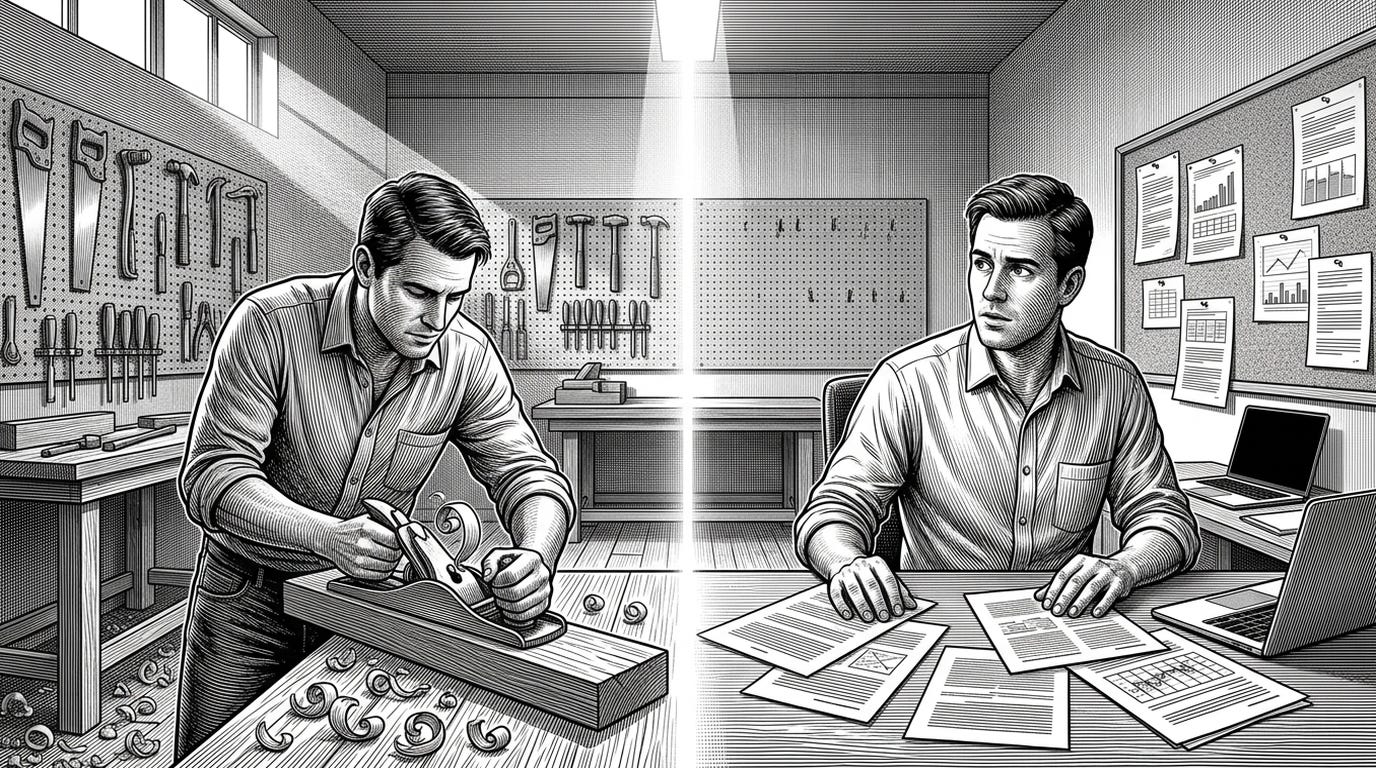
For 20 years, people trained one specific cognitive mode. Call it doer brain. Doer brain writes the code, drafts the email, builds the slide, and ships the feature. It’s hands-on, sequential, and generative. It runs on flow. You start a task, you finish a task, you feel the small click of completion, you move on. Your body knows when the work is done because your hands stop moving.
Doer brain has a built-in recovery system. When the task closes, the loop closes. The task drops out of working memory. The cognitive load it was holding releases, and your nervous system can shift toward recovery. You go for a walk. You make coffee. You feel like a person again.
Then AI showed up.
Now your job is evaluating the code Claude wrote, judging the 3 email drafts Claude offered, and deciding which of Gamma’s slide outputs to keep. The work is still happening. The work is just different. You’ve moved from doing to reviewing. From generating to judging. From craftsman to critic.
Welcome to reviewer brain.
Reviewer brain is a different cognitive mode entirely. It runs on judgment, not flow. It evaluates rather than produces. It compares outputs, spots errors, and makes micro-decisions about taste and direction. It’s the same muscle a senior editor uses, or a film director, or a chess coach watching a student play. It can be deeply valuable. It can also be deeply exhausting in a way doer brain never was.
The structural problem is that reviewer brain has no natural close.
When you write the code yourself, the task ends when the function works. When you review Claude’s code, the task ends when you decide it’s good enough. Those are completely different criteria. The first is closed by reality; the code runs, or it doesn’t. The second is closed by judgment; you decide. Judgment doesn’t ever fully close. There’s always one more thing you could check, one more edge case, one more version to compare. The loop stays open. The body never gets the “we’re done” signal.
Multiply that by 30 micro-tasks a day. Multiply it again by the fact that reviewer brain is also juggling 3 parallel agents, each producing output that demands evaluation. By 5 pm, your nervous system has been making judgment calls for 9 hours straight without a single satisfying close. The tiredness has a different texture. Scrambled, not depleted. You can’t remember what you ate. You stare at the fridge.
That’s what’s underneath AI brain fry. A recovery system built for doer brain trying to recover from a day of reviewer brain. The signals never came. The loops never closed.
Here’s what helps.
Using less AI won’t fix it; AI isn’t going away, and pretending otherwise wastes time you don’t have. The fix is to upgrade your recovery system to match the work you actually do now. 3 things help. I’ve tested all of them.
Close the loops manually. Reviewer brain doesn’t close on its own. You have to do it. At the end of each AI-assisted task, write one sentence that says “this is done, moving on.” Out loud is better. The point is to give your nervous system the signal that the day’s brain never naturally provides. It feels ridiculous, but the difference in evening energy showed up within a week.
Batch reviewer brain. Protect doer brain. Stop ping-ponging between writing and judging all day. Pick a window where you let Claude run, and you review the outputs in one block. Then close the laptop on AI and spend 30 minutes doing something with your hands. Write in a journal. Cook a new recipe. Read a book. Play a board game. Anything that triggers the old doer-brain reward loop. People who do this report feeling like themselves again within a week.
Build recovery that matches the load. Doer-brain recovery used to be light: a walk, a coffee, a chat with a colleague. Reviewer-brain recovery has to be heavier because the cognitive cost is heavier. Long aerobic exercise. Time with no screens. Sleep that you actually defend. If you’ve added AI to your stack and kept the same recovery rituals, you’re running a 2026 cognitive load on a 2019 recovery budget. The maths doesn’t work.
Here’s the deeper point: every person I know is operating under the assumption that AI gave them more capacity. Look at the data, and you’ll find the opposite. AI gave them more output. Capacity stayed flat or shrank. The gap between output and capacity is what’s destroying them. The output numbers look great, which is why the problem stays invisible.
The work changed, but the operating system you’re running it on hasn’t caught up. That’s the whole problem. After all, you’re only human. And if you try to match the capacity of a machine, you’ll fail.
Do the human thing. Look after yourself, observe where you’re at, and change the way you do things. Prioritise sleep, exercise, and healthy food. None of this is new information. But in a time where intelligence is abundant and you can literally build anything, recognise that your hardware (your body) has not changed.
The only constant in life is change, and humanity is known for adapting throughout the ages.
Before you upgrade your recovery, find out where the load is actually landing. It takes less than 5 minutes and gives you 5 signals: thestillarchitect.com/diagnostic