
Your recovery is making you worse
Most professionals know how to rest. Almost none know how to recover.

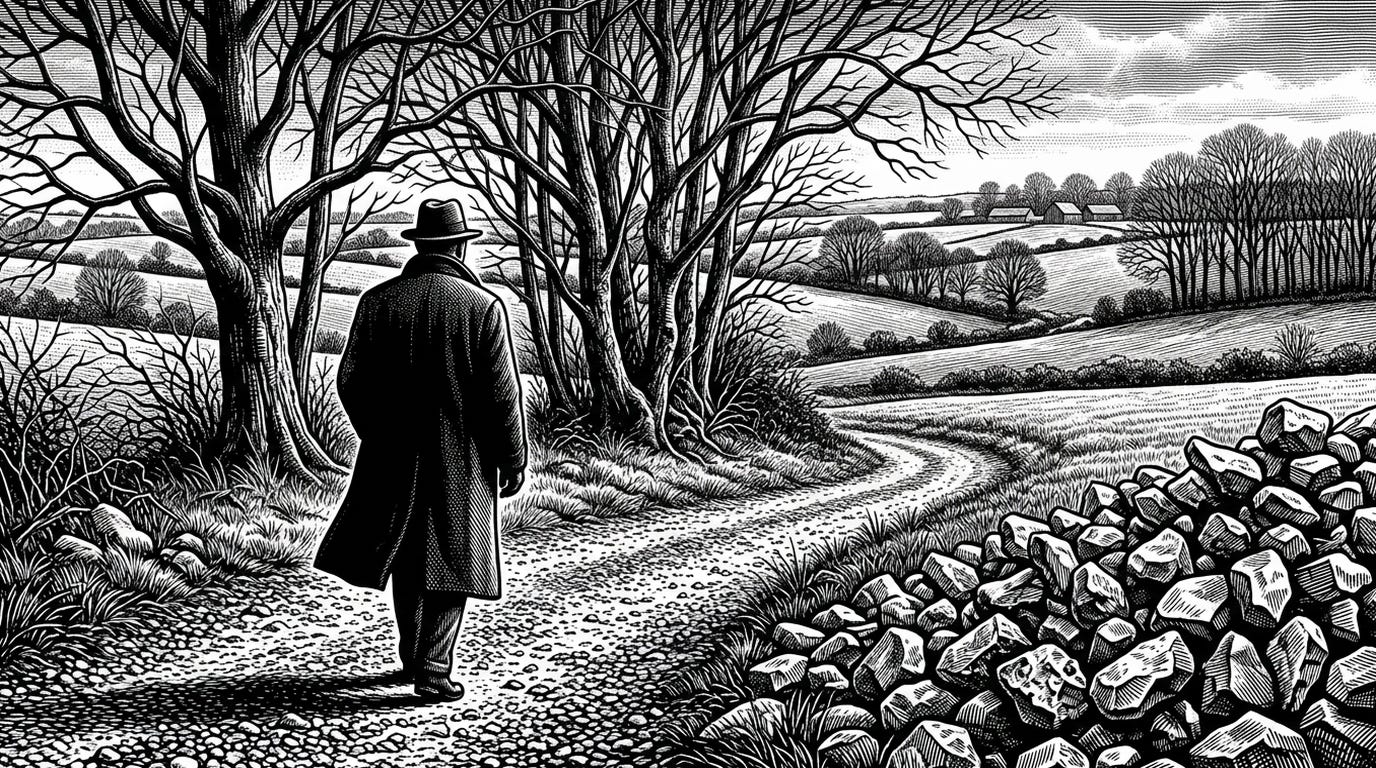
The gravel path made a loop through a small grove of trees behind the house. Every morning, around noon, a man in a dark cloak would step onto it and begin walking. He walked slowly, deliberately, as if measuring something. At the edge of the trail, he’d placed a pile of flint stones. After each lap, he kicked one aside. When the stones were gone, so was he - back inside, back to his study, back to work.
The man was Charles Darwin. The house was Down House in Kent, where he’d retreated after returning from the HMS Beagle voyage with a body that no longer cooperated with his mind. The illness was mysterious and punishing - weeks of vomiting, hands that trembled, a head that swam. “All this winter I have been bad enough,” he wrote to a friend, “with dreadful vomiting every week, and my nervous system began to be affected.”
He was 33 when the symptoms started. They never stopped.
He didn’t push through. He didn’t take a sabbatical. He didn’t try to will himself into productivity.
He redesigned his entire day.
Three work sessions of 90 minutes each. Never more. Between them: the Sandwalk. Letters read aloud with his wife, Emma. Lunch with his children. An afternoon rest. Backgammon in the evening. Piano music. Bed by 10.
On this schedule - roughly 4 hours of focused work per day, surrounded by a scaffolding of movement, family, rest, and play - Darwin wrote On the Origin of Species. And then 11 more books. Plus thousands of letters. Plus decades of empirical research that changed how humans understand life itself.
The most productive scientist of the 19th century built his life’s work on 4 hours a day. The other 20 hours were recovery.
Your day looks nothing like Darwin’s. Calendar, Slack, back-to-back meetings until 4 pm, “deep work” slotted into whatever’s left.
But you know what depletion feels like.
You’ve felt it on a Friday evening when you collapse onto the couch and reach for the remote, not because you want to watch anything, but because choosing something harder requires energy you don’t have. You’ve felt it on the first Monday back from leave, when 2 weeks of ease evaporated somewhere between the commute and the 9 am standup. You opened Slack before your coffee. By Wednesday, it was like you never left.
You know how to rest. You do it every weekend. You’ve taken the vacation. You’ve slept in on Saturdays. You’ve binged an entire season of something you can’t remember the name of by Sunday night.
And you’re still exhausted.
Not the kind of exhaustion that sleep fixes. The kind where you wake up at 7 am on a Saturday, stare at the ceiling, and think: I should be rested. Why don’t I feel rested?
The people around you would say you need more rest. More time off. A longer holiday. But you’ve had the rest. You’ve had the time. You’ve had the holiday. And everything you’ve done to recover has been pausing the withdrawals without making any deposits.
Darwin didn’t arrive at his routine by reading about productivity. He arrived at it through collapse. His body gave him no choice. He couldn’t sustain more than 90 minutes of concentrated thought before the trembling started, before the nausea crept in. So he built his day around what he could sustain, and filled the rest with activities that restored what his work consumed.
He designed each gap with the same precision he brought to his research. The Sandwalk was a circuit: fixed distance, measured by stones, walked at the same hour every day. The letters with Emma happened at the same time each afternoon. The evening backgammon had rules, a score, a winner. Every gap had a shape. None of them were filler.
On his worst days - and there were many - Darwin couldn’t have chosen to recover. He could barely make it to the Sandwalk. But the architecture didn’t require him to choose. The path was already laid. The stones were already placed. The routine carried him when his willpower couldn’t.
Psychologist Sabine Sonnentag calls it the recovery paradox: when work demands are highest and recovery is most needed, people are least likely to engage in the behaviours that actually restore them. The self-regulatory resources required to choose a walk over the couch, a hobby over a screen, are the exact resources that a depleted workday has already consumed.
Every professional who’s ever thought I know I should go for a walk, I just can’t make myself do it after work has lived this paradox. The intention is real. The capacity isn’t. And the gap between the two isn’t a character flaw. It’s a design flaw.
Darwin’s architecture bypassed the paradox entirely. His body had forced him to design what most of us try to choose on the fly. The system carried it from there.
Darwin never took a vacation from his routine. He didn’t need to. His architecture made deposits every day - small, frequent, woven into the hours between work - so there was never a deficit large enough to require a 2-week correction.
Most professionals do the opposite. They accumulate debt all week, all quarter, all year, then try to repay it in a single lump sum. Kühnel and Sonnentag tracked 131 teachers before and after their holidays and found that vacation benefits - the reduced exhaustion, the renewed engagement - faded completely within 2 to 4 weeks. For those who returned to high workloads, the fade-out happened even faster.
The vacation didn’t fail. The architecture waiting on the other side consumed every deposit the vacation had made. A holiday without architectural change is a loan against the same system that broke you. The interest compounds the moment you return.
Darwin’s body budget never needed a large correction, because his daily architecture never let the deficit compound. Each walk, each game, each quiet afternoon was a deposit. The Sandwalk gave him distance from the work. The backgammon gave him a small win that had nothing to do with barnacles or finches. The letters with Emma gave him company that asked nothing of him. His recovery was a portfolio, distributed across every waking hour he wasn’t writing.
Recovery is infrastructure you design into every day.
When you’re depleted, your brain defaults to the cheapest option available. The screen. The couch. The scroll. These feel like recovery because they require nothing. But they provide nothing either: no detachment, no mastery, no meaning. Just a pause button on the same architecture that’s draining you.
Every morning, Darwin placed his flint stones at the edge of the Sandwalk. He didn’t count the hours he worked. He counted the laps he walked. The stones were his metric: not productivity, not output, not the next chapter finished, but recovery completed.
Your version of the Sandwalk doesn’t require a gravel trail or a country estate in Kent. It requires one protected gap in your day where recovery stops being a reward for finishing and becomes the thing that makes finishing possible.
Not the Netflix queue. Not the scroll. Something that asks a little of you and gives back more than it costs.
Start with one stone.
One more thing.
I’ve spent the past year building something that puts everything I write about into a system you can actually use. It’s called The Refactor: 7 modules, 26 AI prompts, and you build a personalised operating system as you go. It starts with your biology and works outward from there.
I’m opening it to 30 founding members at $97 before the price goes to $297. You’re reading this newsletter, which means you already know the philosophy. The Refactor is the architecture.
If that’s interesting to you, see The Refactor: founding member pricing.
If it’s not the right time, I’ll be here next Friday with another article.
How much capacity are you actually running on? The Capacity Score is a free 2-minute assessment that shows you exactly where your system is leaking. One number and the clarity to know what to fix first.
Take the Capacity Score.