
Stop wasting time on time
Why the busiest professionals keep falling further behind

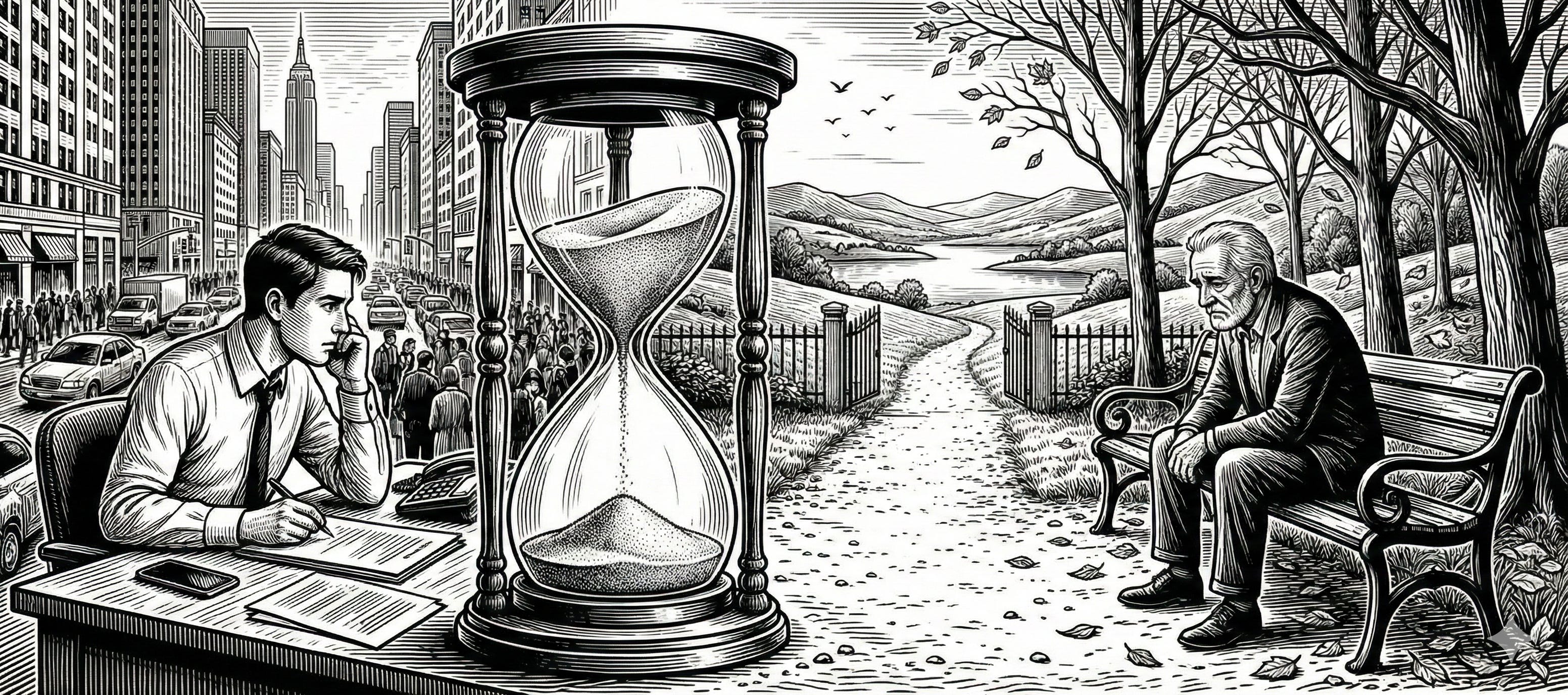
In 1830, Victor Hugo had a problem. He’d signed a contract to deliver The Hunchback of Notre-Dame. He’d already missed one deadline. His publisher gave him six months: no more extensions.
Hugo was one of the most celebrated writers in France. He had time. What he didn’t have was the ability to use it. Paris kept calling. Dinner parties. Salons. Visitors who expected the great Victor Hugo to entertain them. He was drowning in yeses.
So he did something drastic. He gathered every piece of clothing he owned and locked it in a chest. He gave the key to his servant with strict instructions: do not return it. Then he bought a large grey knitted shawl and confined himself to his study. He couldn’t leave because he’d be humiliated - one of the most famous men in Paris, shuffling through the streets in rags. The social cost was too high. He’d engineered his own friction, a barrier between himself and his own weakness for distraction. Notes slid under the door. The outside world continued without him.
He finished the novel in five months.
Hugo didn’t need a better calendar. He didn’t need more hours. He needed to make distraction impossible because he couldn’t trust himself to refuse it. His problem was never time. It was the thousand small yeses that had colonised his days without his permission.
Hugo saw what most busy people refuse to admit: the obstacle wasn’t the clock. It was him.
Here is what no one tells you about being busy: it feels like a problem, but it functions like a solution.
Busyness answers an uncomfortable question before you have to ask it. If every hour is filled, you never have to decide what actually matters. You never have to sit with the discomfort of choosing, which means you never have to feel the weight of what you’re choosing against. A packed calendar is a defence mechanism. It looks like a productivity problem. It’s actually an avoidance strategy.
Debbie Millman named this directly: “Busy is a decision. We do the things we want to do, period. If we say we are too busy, it is just shorthand for the thing being ‘not important enough’ or ‘not a priority.’ Busy is not a badge.”
There’s a second layer. Saying yes is easy. Saying no requires you to disappoint someone, and disappointment has a cost. So you say yes to the meeting, yes to the favour, yes to the project that doesn’t matter, because the momentary discomfort of refusal feels worse than the slow bleed of an overcrowded life. You say yes to drinks with colleagues when you promised your kid a bedtime story. You say yes to the weekend work request when your body is begging for rest. You say yes to everyone else’s priorities because their requests are immediate, while your own goals feel like they can wait. You’re not bad at time management. You’re conflict-averse. Every yes is a trade, and you’ve been making trades you can’t afford.
The calendar isn’t the problem. The calendar is the symptom.
You’ve been optimising the wrong thing. Rearranging appointments, installing apps, waking up earlier, all while avoiding the real work: deciding what matters and accepting the cost of protecting it.
The Stoics had a phrase for taking ownership of one’s life: proairesis - the faculty of choice. Not the circumstances you face, but how you respond to them. The first step isn’t doing more. It’s deciding less.
Your brain isn’t built for what you’re asking it to do. Dr. Sophie Leroy at the University of Washington discovered what she calls “attention residue” - when you switch tasks, part of your mind stays stuck on the previous one. The residue accumulates. By midday, you’re thinking about six things at once and doing none of them well. Research from the American Psychological Association puts the cost at 40% of your productive time. You’re not slow. You’re fragmented.
The solution sounds almost too simple: stop switching.
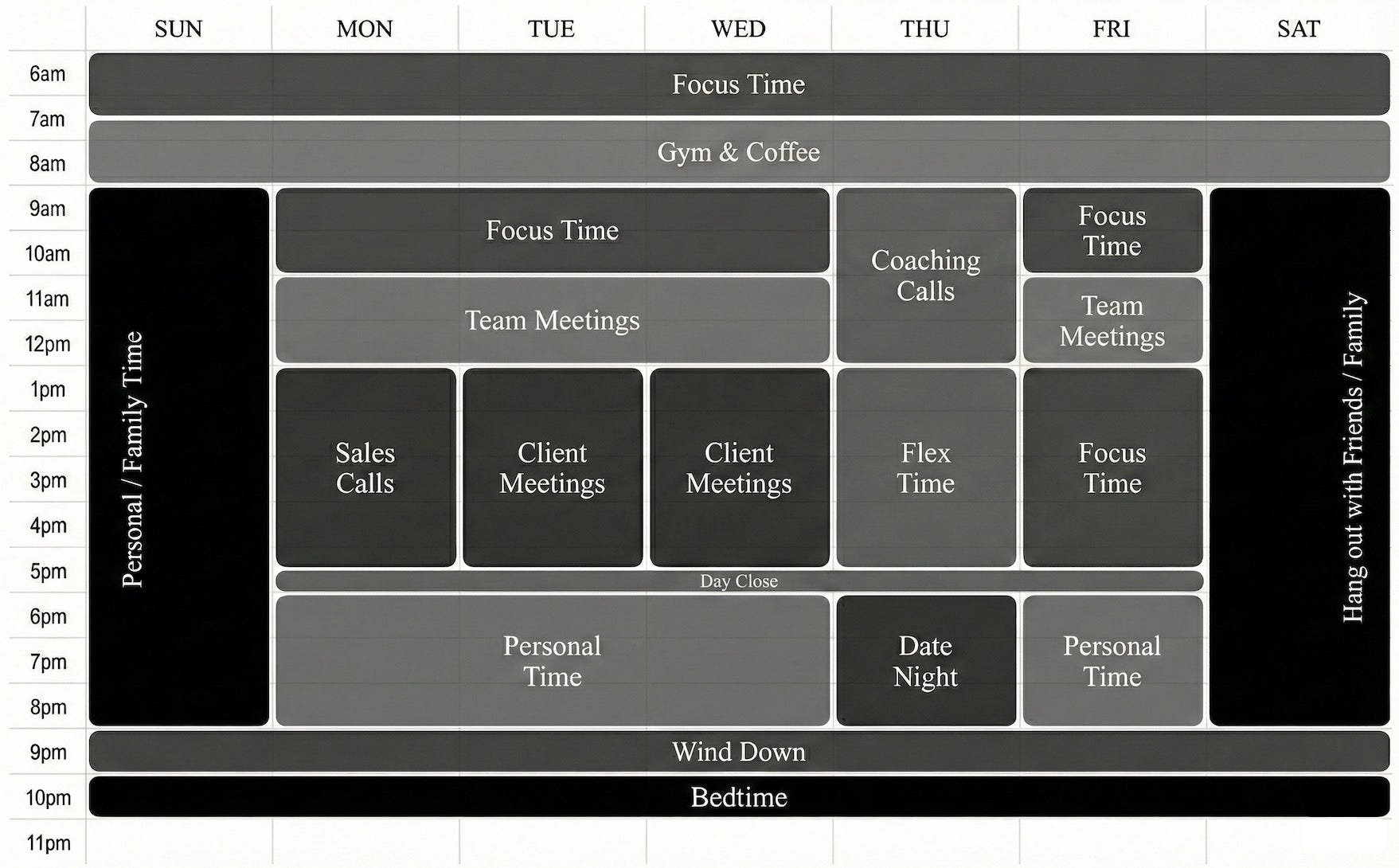
Jack Dorsey ran Twitter and Square simultaneously by refusing to mix them. Monday was management at both companies. Tuesday was product. Wednesday was marketing. Thursday was partnerships. Friday was culture. He didn’t juggle, he batched. One theme per day. One mode of thinking. One type of decision. Cal Newport estimates that a 40-hour week structured this way produces what a 60-hour chaotic week cannot.
There’s a difference between spending time and investing it. You can spend an hour at the gym, going through the motions, checking your phone between sets, leaving the same as you arrived. Or you can invest that hour, focused, intentional, extracting every ounce of value from the sixty minutes you’ve committed. Same hour. Completely different return. The goal isn’t to find more hours, it’s to get more from the hours you already have.
The prescription isn't adding another productivity app. It's subtracting the chaos. Theme your days. Batch similar work together. Protect blocks of uninterrupted time like they're sacred, because cognitively, they are. Your brain needs time to settle into a task before it can do its best work. Every Slack message resets that clock. Every email. Every notification you didn't turn off on your phone.
I theme my days. The result: 8-hours of protected deep work per week. Here’s an example to get you started:
Ryan Holiday put it simply: “Say no. Own it. Be polite when you can, but own it. Because it’s your life. And because it is your power.”
The transformation isn’t from disorganised to organised. It’s from reactive to intentional.
Victor Hugo didn’t need better time management. He needed to stop letting Paris manage him. You don’t need another system. You need fewer things competing for the same hours, and the discipline to protect what remains.
Victor Hugo finished The Hunchback of Notre-Dame in five months. The novel outlasted the empire, the century, and the man himself. He didn’t find more time. He found clarity, and then he protected it with everything he had, including his dignity.
You’re not locked in a room in Paris, wearing rags to keep yourself from leaving. But you are at the same fork Hugo faced: keep saying yes to everything, or decide what actually matters and build a wall around it.
The Stoics left us a phrase worth carrying: memento mori - remember that you will die. Not as morbidity, but as clarity. Time is not infinite. Every yes to something trivial is a no to something that matters. Every fragmented hour is an hour you don’t get back.
James Clear put it plainly: “You need focus to become exceptional at anything. Massive amounts of time and energy are wasted optimising things that should be left undone. You have to be great at saying no.”
You don’t have a time problem. You have a choice to make.
Stop spending your time. Invest it. Make the right choice.