
Discipline is where good systems go to die
A 15-minute exercise to redesign your defaults and stop relying on willpower

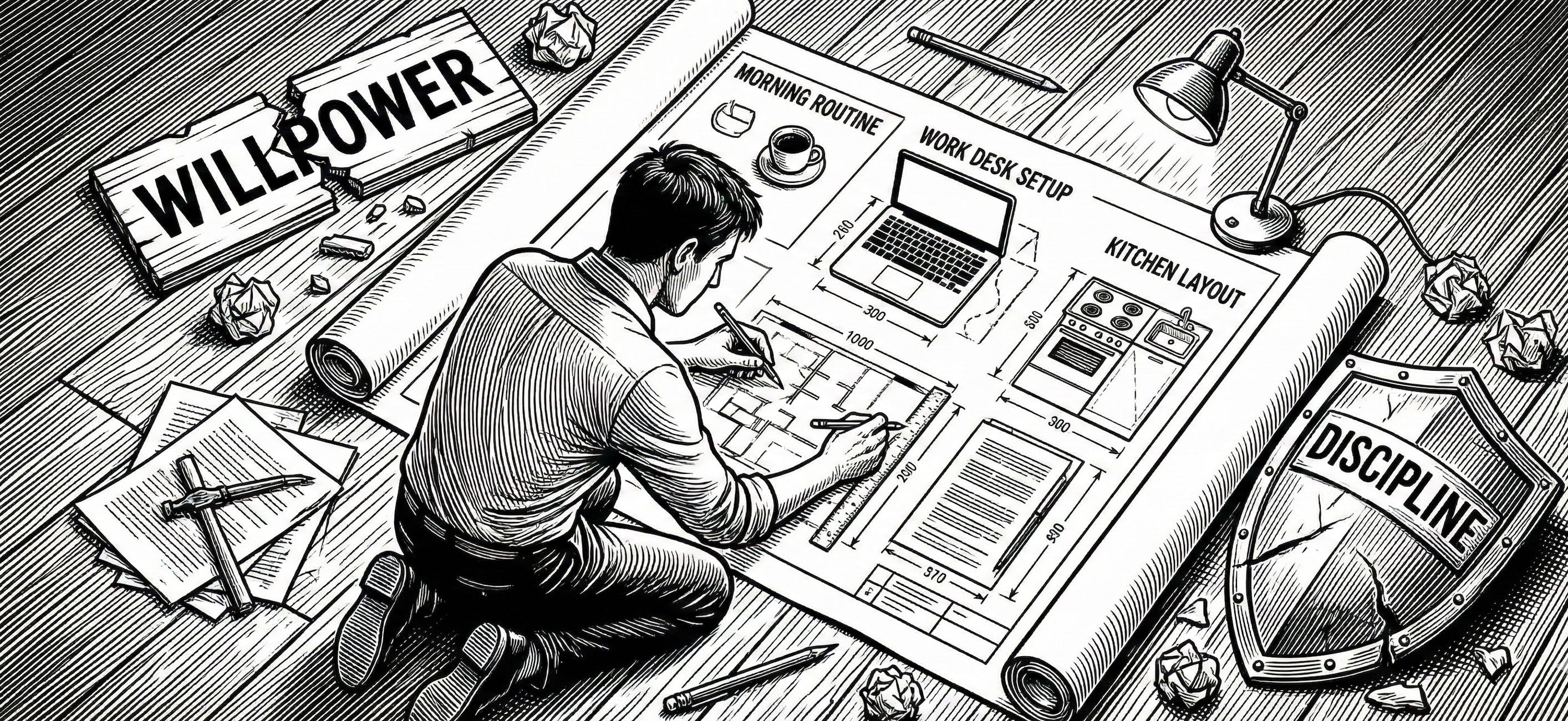
In the 8th century BC, Homer told a story about a man who knew he couldn’t trust himself.
Odysseus was sailing home from Troy. His route passed the Sirens, creatures whose song was so beautiful that every sailor who heard it steered toward the rocks and drowned. No one had ever resisted. The song was perfect. The pull was absolute.
Odysseus wanted to hear it. But he wasn’t arrogant enough to believe he could resist it. So he designed a system. He ordered his crew to fill their ears with beeswax. He had them lash him to the mast with ropes he couldn’t break. And he gave one instruction: no matter what I say, no matter how I beg, do not untie me.
The ship passed the Sirens. Odysseus screamed. He thrashed. He pleaded with his crew to release him. The system held. The ship sailed on.
He didn’t resist the song. He made resistance unnecessary.
3,000 years later, we’re still worshipping the wrong virtue. We celebrate the person who says no to the cake. We should be celebrating the person who never put it on the counter.
Odysseus survived because he understood something most people never admit: discipline is where good systems go to die.
Here is what no one tells you about discipline: every act of it is a confession. It’s your brain admitting that the environment you’re operating in is working against you, and you’re burning cognitive fuel to override it.
Consider the open-plan office. You need 90 minutes of unbroken focus; the kind of deep work where flow becomes possible, where your sharpest thinking meets your hardest problems. I wrote previously about protecting your peak window; those 2 to 4 hours when your cognition runs hottest. But protection means nothing if you’re sitting in the path of every passing conversation, every shoulder-tap, every colleague who needs “a quick 5 minutes.” You can try to discipline yourself into focus. You can put on headphones and hope. Or you can get up, book a meeting room, move to a different floor, and find a corner of the building where no one knows to look for you. Change the environment. Remove the interruption at the source.
One of those approaches costs willpower. The other costs 30 seconds of calendar admin.
This pattern repeats everywhere. The person who keeps snacking at their desk isn’t undisciplined; they sit 10 feet from a communal kitchen. The person who can’t stop checking email isn’t weak; notifications are firing every 3 minutes on a screen they can’t avoid. The person who never exercises after work isn’t lazy; they commute home first, and once the couch has them, the couch wins. Every one of these is a discipline problem on the surface. Underneath, every one of them is a design failure.
Psychologist Wendy Wood’s research at the University of Southern California found that roughly 43% of daily actions are performed habitually, driven not by conscious decision but by environmental cues. Nearly half of what you do each day isn’t chosen. It’s triggered.
You’re not undisciplined. You’re under-designed.
The shame you carry about your lack of willpower is misplaced. It belongs with the system, not with you.
The Stoics had a practice called praemeditatio malorum; the premeditation of evils. Before each day, they’d imagine what could go wrong. Not as pessimism, but as design. If you know where the failure points are, you can build around them before willpower is ever required.
Seneca advised: “The wise man looks ahead, not to predict the future, but to prepare for it.” He wasn’t talking about resilience. He was talking about architecture. Anticipate the weak point. Engineer the solution before the moment of temptation arrives.
This is what environmental design looks like in practice. Not inspiration. Not motivation. Infrastructure.
You don’t check your phone during deep work because you locked it in a drawer before you sat down. You don’t skip the gym because your bag is packed and sitting by the front door, and you drive there straight from the office before going home. You don’t buy overpriced takeaway at lunch because you cooked extra last night and the container is already in your bag. You don’t get derailed by Slack at 8 am because you turned off notifications until 10. Every one of these is a decision made once, in a calm moment, so you don’t have to make it again in a weak one. Engineers call these forcing functions: design choices that make the desired behaviour the path of least resistance and the undesired behaviour effortful.
The research supports the instinct. A 2018 study in Personality and Social Psychology Review found that people who score high on self-control don’t actually exert more willpower than others. They encounter fewer situations that require it. They structure their lives so the right choice is easier. The “disciplined” person isn’t gritting their teeth more than you are. They built a better kitchen. You’re staring at the pantry and trying to resist.
So where do you start? With what I call a Friction Audit. It takes 15 minutes. Draw two columns on a piece of paper. Column A: things you want to do but don’t. Column B: things you don’t want to do but keep doing. For each item, identify the friction. Column A has too much of it. Column B has too little. Your job is to flip it.
The gym never happens after work because you go home first, and once you’re on the couch, inertia wins. So you pack your bag the night before, put it by the front door, and drive to the gym straight from the office. The friction of going home first is gone. You keep buying overpriced lunches because there’s nothing in the fridge. So you cook double portions at dinner and pack the leftovers before you go to bed. The healthy option is now the easiest option. You can’t focus in the mornings because Slack notifications start firing at 8 am. So you turn off notifications until 10 and put your phone in a drawer. The interruption now requires you to physically stand up and retrieve the device; 3 seconds of friction that stops 90% of the impulse checks.
Now the other column. You scroll social media for 40 minutes every evening because the app is on your home screen. Move it to a folder on the 3rd page. Log yourself out so you have to re-enter your password every time. The behaviour isn’t blocked; it’s taxed. You keep saying yes to meetings that don’t need you because the calendar invite arrives, and clicking “accept” is easier than writing a decline. So you set a rule: every invite sits for 2 hours before you respond. The delay creates space for the question you weren’t asking; do I actually need to be in this room?
One evening. Two columns. A redesign that costs nothing, but changes the defaults you live inside every day.
Use this free Notion template to get started.
Ryan Holiday put it plainly: “The best way to handle temptation is to avoid it entirely. Set up your life so you’re not constantly testing yourself.”
The transformation is from self-control to system control. From fighting your environment to designing it. From spending willpower to making it unnecessary.
You don’t need a stronger will; you need a better blueprint.
Odysseus didn’t sail past the Sirens because he was stronger than every sailor who’d drowned before him. He sailed past because he was honest enough to admit he wasn’t. The ropes did the work. The system held when the man couldn’t.
Your sirens look different. The notifications. The open-plan noise. The meetings that could’ve been emails. The thousand small defaults you inherited and never questioned. Every day you spend willpower fighting them is a day you’ve accepted the architecture someone else built.
The Friction Audit is sitting there. Two columns. 15 minutes. A Sunday evening and a pen.
Marcus Aurelius, writing to himself in the cold hours before dawn, put it simply: “Waste no more time arguing about what a good man should be. Be one.”
Not tomorrow. Not when conditions improve. Not when you feel more disciplined.
The conditions won’t improve. But the environment can. And you’re the architect.
Build.
If you want to go further than defaults, The Refactor is coming.
This is really insightful!
Wow, this aligns so closely with what I’ve been wrestling with in my own writing.
The idea that discipline isn’t about willpower, it’s about system design, feels profoundly right. The best systems don’t depend on heroic effort. They shape the range of possible decisions so that good outcomes become the natural path.
That’s exactly how I’ve been thinking about autonomy governance. If we want agents to be trustworthy, governance can’t be advisory. It has to be architectural. We don’t give agents infinite freedom and hope they behave, we bound the choice surface intentionally.
What struck me most reading this, though, is how much this extends beyond technology.
Life itself is just another layer of system. Habits, environment, constraints, incentives; they shape us the same way architecture shapes agents. Discipline in life, just like in distributed systems, isn’t about control for control’s sake. It’s about designing the environment so that the right behavior becomes sustainable.
Great systems are disciplined systems.
Disciplined systems are bounded systems.
And bounded systems (whether human or artificial) are the ones that actually endure.