
The human half of the machine
What 27 years in a cell prove about the brain you think you've already used up

He had been a senior engineer for ten years when he wrote it down. The line was: “I’ve woken up and 5 years have gone by, and I’ve just coasted into a position where I feel very, very stuck.”
He posted it on Reddit at midnight. The thread sat there for three days, accumulating quiet replies from people who recognised themselves in the sentence. His employer had just announced a company-wide push on AI coding tools. Every rollout email widened the gap he was already tracking. He used the word “deskilling” to describe what was happening to him.
He was 35.
Nelson Mandela sat down with an Afrikaans grammar book in a cell barely wider than his arm span. He was 44 the year they brought him to Robben Island. He had 27 years to go.
The Afrikaners had jailed him. The language he was teaching himself was theirs. His comrades thought he was wasting his time, or worse, fraternising with his captors. He kept studying. He said you needed to understand the men who held the keys, and to do that, you needed their idiom. Decades later, when the secret negotiations began with the apartheid government, he conducted them in Afrikaans. His wardens had become his first students of what was possible.
In the years that followed, he kept adding. Languages. Law. He completed a law degree at 70, finishing it months before his release.
You don’t need a Robben Island to arrive at the same audit. You can have everything Mandela didn’t and still find yourself standing inside it.
A team lead writes about a Friday call with one of his contractors. The contractor’s work was broken and he sent through what the team lead described as a monstrosity: an over-engineered solution to a problem that needed a single line of code. The team lead asked how he had built it. The contractor’s reply: “I used ChatGPT to write this.”
The team lead is the one watching his craft dissolve into someone else’s autocomplete. The year he became a senior engineer, the skill the contractor had just outsourced was what distinguished him from his peers. A decade of practice is now a feature anyone can rent for $20 a month. He doesn’t know whether to teach the contractor what to actually look for, or to go and learn the tool that just out-shipped him for an order of magnitude less than his salary, on a Friday afternoon, by someone he was supposed to be supervising.
The scene generalises. The senior consultant watches it with a deck. The finance director watches it with a deal sheet. The lawyer watches it with a clause library. The clinician watches it with a discharge summary. The skill that took you a decade to build is being replicated on a free trial by someone with five years less experience than you. The specifics differ. The pattern is the same.
The real question is whether the version of you that did the work still has a job description.
What Mandela’s 27 years prove is that the answer is yes, even when nothing seems to help you.
He had no internet, no AI tools, no peers learning in parallel, and no sabbatical. He had a seven-by-eight-foot cell, a limestone quarry by day, and the night hours. He used the night hours to add. By the time he negotiated his country out of apartheid, the man who walked out of Victor Verster Prison wasn’t the man they’d sent in. Eleanor Maguire’s research on London cab drivers found the spatial-memory region of their brains grew measurably larger the longer they drove, adult brains physically restructuring in response to years of sustained navigational demand. A quarry instead of a steering wheel. A grammar book instead of memorising a city’s streets. Same brain, doing what brains do when you keep changing what you ask of them.
He’d kept changing what he repeated.
A senior data scientist who had been an early evangelist for AI tools at his own company posted recently about what two years of heavy use had done to him. “Up until I started making heavy use of these tools, every month I felt like I was becoming a better engineer,” he wrote. “Not anymore.” He’d thought he could use them strategically and stay sharp. He was wrong.
That line, “not anymore”, is the most credible thing I’ve read on this subject in two years. He was reporting his own degradation from the inside.
His first response was to go home and hand-code a programming language he’d always avoided, line by line, on a project that didn’t matter to anyone. He said it felt like being a first-year student again. That’s one valid form of the fix. The deeper principle is broader: he had been using the tool in a way that let his judgment go quiet.
Microsoft and Carnegie Mellon ran a study on 319 knowledge workers, published at CHI 2025. Their finding was exact: by mechanising routine tasks and leaving exception-handling to humans, you deprive humans of the routine opportunities to practise their judgment, leaving them unprepared when the exceptions do arise. Higher confidence in AI correlated with less critical thinking. The risk was the stance toward the tool.
Andrej Karpathy, who co-founded OpenAI and built Tesla’s autonomous driving programme, said it plainly at Sequoia’s AI Ascent conference earlier this year:
“You can outsource your thinking, but you can’t outsource your understanding.”
That’s the whole argument.
The famous chess grandmaster, Garry Kasparov, lost to Deep Blue in 1997. He spent the next several years thinking carefully about what had happened. Then in 2005, an online freestyle chess tournament put a crack in everything he thought he knew about machines. Anyone could enter. Humans could use any computer assistance they chose. The winners were two amateur players running off-the-shelf chess engines, who had built a better process than the grandmasters paired with stronger computers had built for theirs. They understood the game well enough to know when the computer was wrong. They framed problems precisely enough to give the machine the right one.
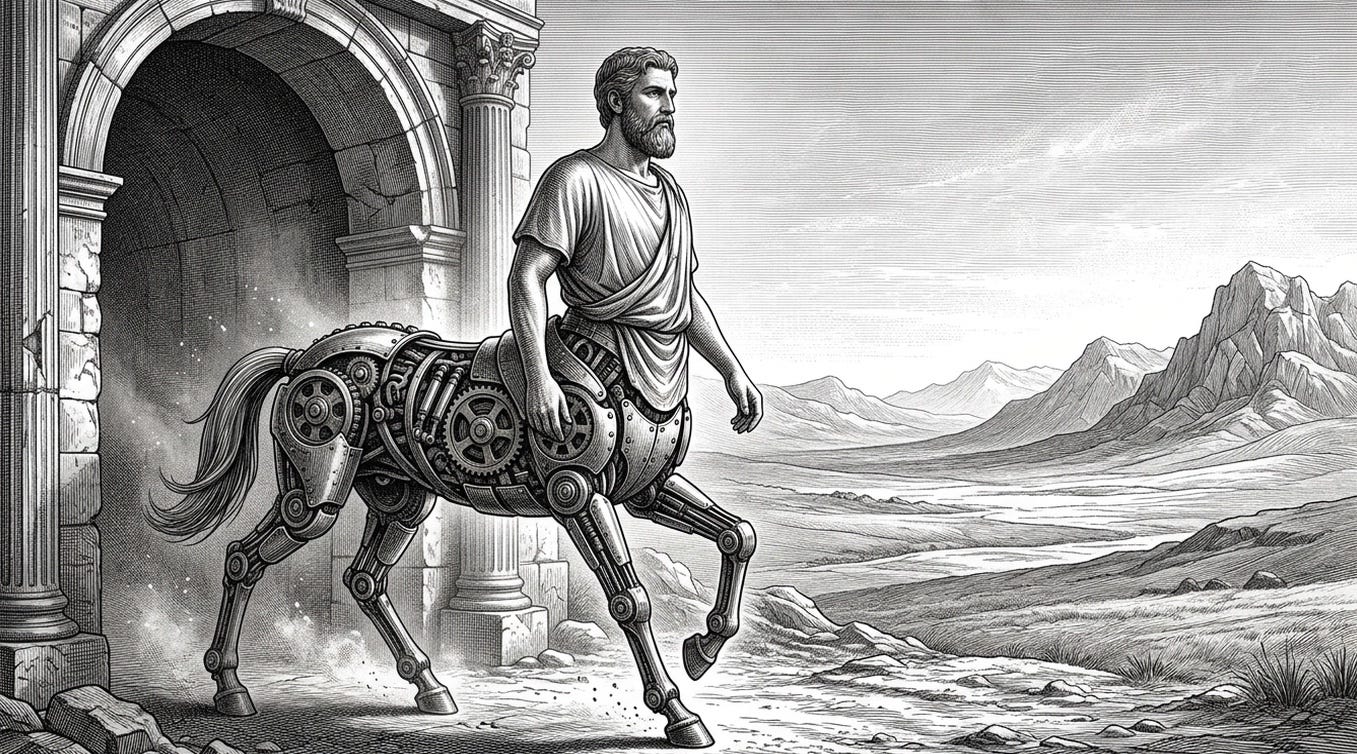
Kasparov called them centaurs. The human half of the centaur determines the ceiling. The machine executes. The human frames, judges, and catches the errors the machine can’t see in itself.
The data scientist who felt himself degrading had stopped being a centaur and had become a passenger. He was ratifying outputs he no longer had the depth to interrogate. His hand-coding experiment was the fastest path back to that depth, for the kind of work he does. Your path will look different.
The neural pathways that support your problem-solving routines have grown thick from 15 years of use. The same toolkit. The same arguments rehearsed in slightly different boardrooms. The pathways for everything else have grown thin. You experience the thinning as “being set in your ways,” and you call it age, because that’s the story your culture has handed you.
Mandela had nothing and treated his 27 years as a deliberate redesign. We have everything ever invented, and treat ours as a default we inherit. The system you built for the person you used to be will no longer fit the person you’re becoming. Most of us are unredesigned. We’ve left the original design unchallenged for so long that we’ve started to mistake its inertia for our biology.
You don’t have to rebuild from scratch. What I’ve called the 85/15 rule applies here too: keep 85% of what works, deliberately disrupt 15% of it. The disruption is to preserve the conditions where your judgment fires. Take one cognitive routine you have been running on autopilot for three years and break it on purpose. The way you chair Monday’s meeting. The way you structure the report. The way you brief your team. The way you decide what’s worth your attention. Pick the version you would never normally pick. Do it with full attention for a month.
The engineer who thought he’d coasted into being stuck was running the same problem-solving moves at 35 that made him a senior at 25. Ten years of the same moves on slightly different problems. The pathways got thicker. Everything else got thinner. Then his employer announced the AI rollout and the gap stopped being theoretical.
The AI rollout sitting in his inbox was already the assignment: the thing that forced him to find out whether his judgment was still his own, or whether it had been quietly rented out.
The people who come out of this transition intact will be the ones who stayed sharp enough to know when the tool was wrong. Mandela completed a law degree at 70. His circumstances were the obstacle. Yours aren’t.
What ages you is the version of you that you’ve been practising for too long without questioning. Keep that version unchallenged long enough and it becomes a life sentence you chose yourself.
Before you redesign anything, find out which routines you’ve been running on autopilot. 5 minutes, 1 number: thestillarchitect.com/diagnostic
Already know this is you? The Refactor is the self-paced rebuild.