

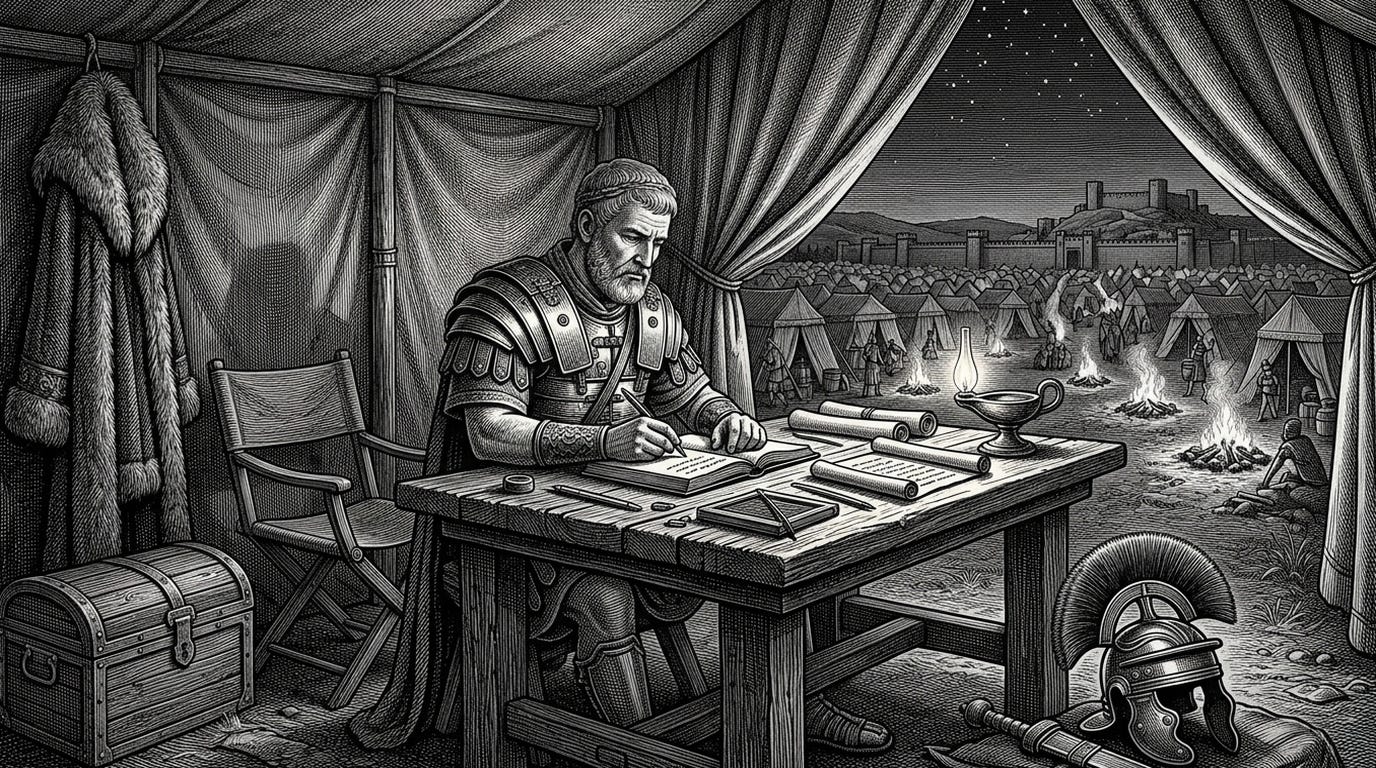
A military tent on the northern bank of the Danube, sometime around 170 AD. Marcus Aurelius picks up his pen. He writes himself a correction: a recalibration of something he’d already told himself before, in different words, under different circumstances, with a different quality of fatigue pulling at his attention.
He’d been doing this for nearly 20 years.
The entries we call the Meditations were never meant for publication. They were maintenance logs: a man watching his own operating system for drift. Book 2 was written during a plague that was killing thousands of his soldiers. Book 10 was written years later, after campaigns that had reshaped the empire and reshaped him in ways he couldn’t have predicted when he first picked up the pen. The concerns shift across books. The language changes. Some themes recur, but with different urgency, as if the same warning required new phrasing because the man reading it was no longer the man who’d written it the first time.
He was updating his philosophy for a version of himself that hadn’t existed when the earlier version was written.
You’ve done this. Built a system on a Sunday afternoon with the kind of clarity that only comes when the week is behind you, and the next one hasn’t started.
You sat down with a notebook, a calendar, and a vision of who you were going to be starting Monday. Deep work from 6 am to 8 am. No email before 9. Exercise at lunch. Phone in the drawer after 7 pm. You wrote it out, colour-coded it, and felt the alignment click into place like tumblers in a lock.
And it worked. For weeks, it genuinely worked. The alarm at 5:45 am felt purposeful. The deep work block was sacred. You were producing at a level that confirmed what you’d always suspected: the problem had never been your ability; it had been the lack of a proper system.
Then something changed. The alarm started feeling different. The deep work block became something you moved, then shortened, then skipped. The evening phone rule lasted 3 weeks before a project deadline dissolved it, and it never came back.
You blamed yourself. Lack of discipline. Lack of commitment. Same conclusion every time: Something is fundamentally wrong with how I’m wired.
The system was designed by a specific person. That person had a specific amount of energy and a specific set of responsibilities. A specific relationship with their work, their family, and their own capacity. The Sunday afternoon version of you: rested, reflective, looking at the week from above instead of inside it.
6 months later, you’re different. Your daughter started school, and mornings now involve packed lunches, lost shoes, and conversations you didn’t plan for but wouldn’t trade. Your role expanded, and the work that used to fit neatly into 3 focused hours now spills across the day in fragments. A friendship deepened, and you’re spending Tuesday evenings in a way that the Sunday planner never accounted for because that friendship barely existed when the system was built.
Each change was small. Individually, negligible. A few minutes here, a shifted priority there, a new commitment that felt like it could fit alongside everything else. But cumulatively, they amounted to a different person. The person following the system was no longer the person who designed it.
The system was outgrown.
Dan Gilbert and his colleagues at Harvard studied this gap between who we are and who we think we’ll become. They surveyed over 19,000 people, aged 18 to 68, and found the same pattern across all ages: people readily acknowledged how much they’d changed in the past 10 years, but predicted remarkably little change in the next 10 years.
18-year-olds expected to stay roughly the same. So did 28-year-olds. So did 48-year-olds. At every stage, people treated the present version of themselves as a finished product.
Gilbert called it the End of History Illusion. “Human beings are works in progress that mistakenly think they’re finished.”
Every system you’ve ever built was designed by someone who believed they were the final version. Someone who looked at their energy, their values, their life as it stood that week, and assumed it would hold. The system was perfectly calibrated for a person who was already disappearing.
There are 2 ways a system stops working. You’ll recognise the first immediately. The second is harder to see.
The first is dramatic collapse. Burnout. A health scare. A relationship that fractures. A morning when you can’t get out of bed because you can’t see the point of the day you’ve designed. Dramatic collapse announces itself. It demands attention. It forces a rebuild, and the rebuild usually gets your friends nodding and telling you they saw it coming.
The second is silent drift.
Silent drift accumulates through small compromises. One skipped review. One exception to the morning routine that became 2, then became the new default. A commitment you stopped keeping because the effort of maintaining it crept above what your changed circumstances could sustain.
From the outside, everything looks the same. The calendar still has the blocks. The alarm still goes off. The system is technically intact. But the alignment between the system and the person running it has been widening in increments too small to notice on any given Tuesday, and too large to ignore by the time you finally do.
Most system failures are drift. Months of it, accumulated in increments you registered as nothing more than a bad week.
Marcus Aurelius understood this. He never treated the Meditations as finished. Book 2 addresses how to tolerate difficult people in language that is taut and nearly angry. Book 7 returns to the same theme, but the urgency has changed: the tone is more patient, more tired, less combative. The same man, the same struggle, a different entry because the drift had shifted the territory underneath him and the old note no longer matched the ground.
His practice was essentially a single question, returned to across decades: *What am I doing out of habit that I wouldn’t choose if I were starting today?*
One question. A sensor, calibrated to detect the gap between who designed the routine and who is living inside it. He noticed the drift, named it, and adjusted. Then he kept going until the drift returned, as it always does, and he adjusted again.
The Meditations are the maintenance log of a man who knew that any system, left unattended, will quietly stop serving the person it was built for.
The system that stopped working succeeded. It did exactly what it was designed to do, for exactly who it was designed for. The fact that it no longer fits is evidence that you grew.
Look back at your last system: the one that felt so aligned when you built it and so hollow when you abandoned it. Most of what you designed still works. The morning structure is sound. The principles behind the calendar blocks are right. The instinct that told you to protect your energy and your attention was correct then and is correct now.
The part that needs redesigning is small. One habit that no longer matches your energy. One time block that was built for a job you no longer have. One assumption about your capacity that expired when your circumstances changed, and you forgot to update the spec.
You need a maintenance cycle. Just one.
The goal was always becoming the kind of person who notices when the system needs updating. Marcus Aurelius spent 20 years noticing. He never arrived at the final version of himself. He never expected to. He just kept placing new notes alongside the old ones, marking where the drift had opened a gap, and closing it before it became a collapse.
The system that lasts is the one with a sensor.
Before you rebuild anything, find out where the drift is costing you. The Capacity Score is a free 2-minute assessment that shows you where your system is leaking. Just one number and the clarity to know what to fix first.