
Everything you've tried has worked. That's the problem.
Andre Agassi won 8 Grand Slams. Every win was a fix for something none of them could reach.

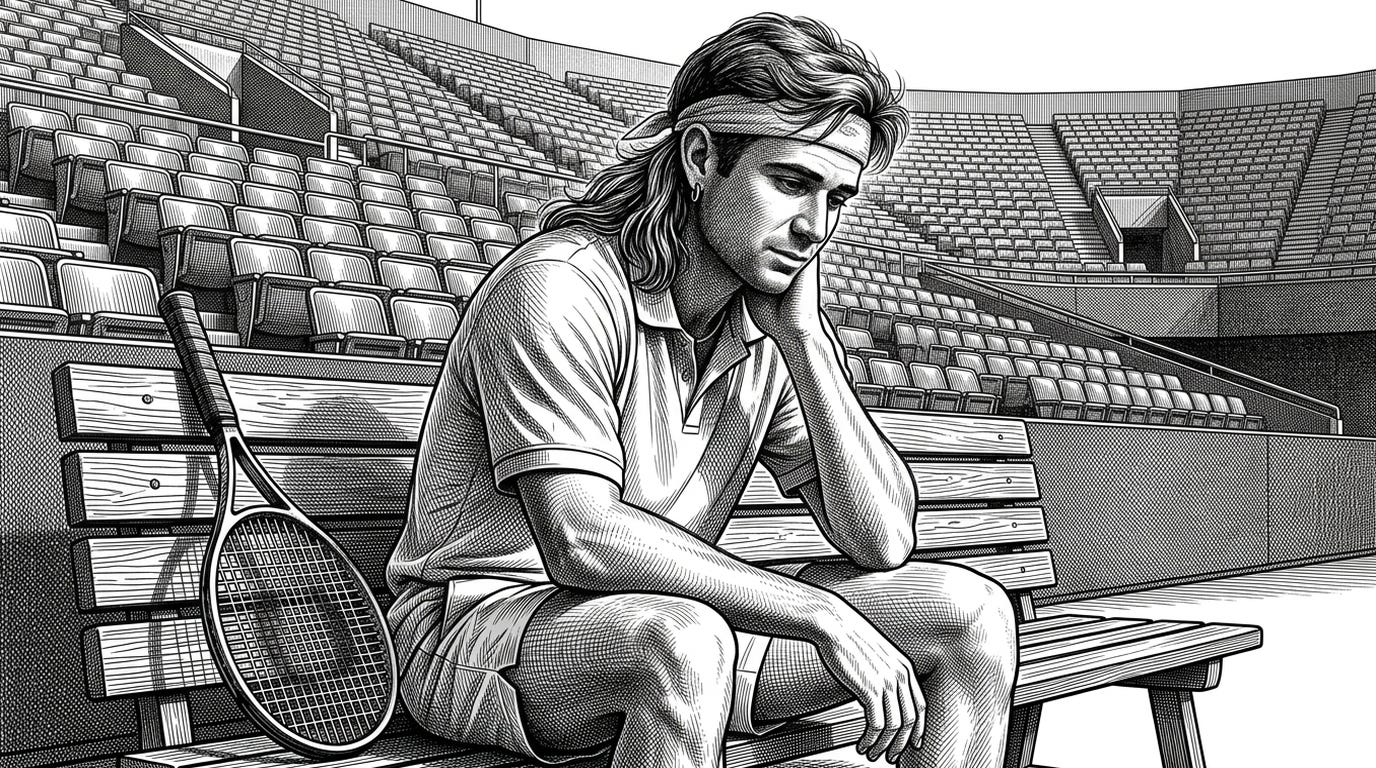
The hairpiece was held together with 30 bobby pins. Andre Agassi checked them before every match, pressing each one flat against his scalp, layering them in rows, then pulling a bandana over the whole construction like a man taping over a crack in the foundation.
He was 20 years old, playing the 1990 French Open final, ranked in the top 5 in the world. And the only thing he could think about was whether his hair would survive 3 sets.
He lost to Andrés Gómez in straight sets. In his autobiography, Open, he wrote that he’d played the entire match in a state of private terror, monitoring his scalp instead of his opponent’s backhand. The best young player in tennis, losing to a problem he’d built with his own hands.
A man solving something with extraordinary competence. And solving the wrong thing.
His father, a former Olympic boxer, had mounted a ball machine in the backyard that fired 2,500 balls a day at his son. By his teens, Andre had the fastest return in the sport. By 20, he was famous. By his early twenties, he was the most recognisable tennis player on earth. And he couldn’t stand any of it.
His response was to fix it. Over and over. Each fix was a genuine act of competence. Each one worked.
The rebel persona worked. The earrings, the denim shorts, the mullet, the “Image is everything” Canon campaign: it gave him an identity that felt more like his own than the one his father had engineered. He became the anti-establishment star of a country-club sport, and for a while, the performance was enough.
The wig worked. When his hair started thinning in his early twenties (a private devastation for a man whose public identity was built on image), the hairpiece preserved the illusion. It worked so well that nobody knew, for years.
The crystal meth worked. After his first marriage collapsed and his ranking began its slide, a year of methamphetamine use did what it always does: it made the emptiness temporarily irrelevant. His ranking dropped to 141 in the world. He failed a drug test and wrote a letter claiming accidental exposure.
The comeback worked. From 141, he rebuilt his body, his game, and his ranking, climbing all the way back to number 1 in the world. He won 6 of his 8 Grand Slams after the crash. By any external measure, it was an extraordinary comeback.
And then the feeling came back.
Every fix had done exactly what it promised. The persona gave him an identity. The wig preserved an image. The meth provided numbness. The comeback delivered proof. And none of it touched the thing underneath: a man playing a sport he’d never chosen, living inside an identity someone else had designed.
Your fixes have been working too.
The meditation app worked. For 3 weeks, mornings felt calmer. Then the notifications started piling up by 8:30 am and the calm evaporated before you opened your laptop.
The 5 am club worked. You got an extra hour. You used it for email.
The job change worked. Six months of oxygen. New faces, new problems, fresh enthusiasm. Researchers call it the honeymoon-hangover effect: satisfaction spikes after a voluntary job change, then declines back toward baseline. Boswell and colleagues measured it in executives and found the same arc every time. The spike. The fade. The familiar hollow.
Daniel Vassallo, a senior engineer who left Amazon after 8 years, put it this way: “Everything was going well and getting better. But my motivation to go to work each morning was decreasing, almost in an inverse trend to my career and income growth.”
The opening line of Agassi’s autobiography reads: “I play tennis for a living, even though I hate tennis, hate it with a dark and secret passion, and always have.”
That sentence took him 36 years to write. It was the first fix that couldn’t be temporary, because it was the first time he’d named the actual problem.
Every fix Agassi tried was competent. Every one delivered what it promised. And every one faded, because competence at the wrong level is just a more impressive way of staying stuck.
If that sounds familiar, pay attention to what the pattern is telling you. When the fix works and the feeling comes back, you’ve located something important: the problem lives one layer beneath every solution you’ve tried. You keep succeeding at something that doesn’t matter.
There’s a reason this cycle feels inescapable. A 2023 study on job satisfaction showed that the treadmill effect is strongest in people whose identity is built around personal advancement and external markers. Faster satisfaction decline after job changes. Quicker return of the itch to leave. People anchored to something beyond their own advancement showed the opposite: satisfaction that grew over time.
According to Gallup, 7 in 10 college graduates get their sense of identity from their job. If you’re reading this, you’re probably in that bracket. And that’s the foundation no fix can reach.
Agassi found this out the slow way. After retiring from tennis, he built the Andre Agassi College Preparatory Academy in Las Vegas: a charter school for at-risk kids, many from the same neighbourhood where his father had drilled 2,500 balls a day at a boy who’d never been asked if he wanted to play. He designed the curriculum. He showed up. He sat in the classrooms and watched kids from backgrounds like the ones his father had escaped learn to read, learn to want something for themselves. He later said the school was the first thing in his life he’d chosen.
You’ve been making visible trades for years: time for money, presence for performance, recovery for output. Those are the ones you can name.
The costliest trades are the ones you stopped noticing. You used to read things that had nothing to do with work. Long Wikipedia spirals. Architecture blogs. Podcasts about deep-sea exploration. Now you read leadership frameworks on the train and call it development. You used to call a friend at 9 pm to talk about something interesting. Now, 9 pm is when you finally open the laptop for the work you didn’t get to during the day.
You traded curiosity for competence so gradually you forgot it was yours.
Those trades compound. By the time you notice what’s missing, you’ve been paying for years.
The next time you reach for a fix (the new role, the routine, the productivity system that promises to make it all feel manageable), pause on one question first: has something like this worked before and faded?
If yes, look deeper. The question is what you built it on top of.
Agassi’s career ended where it began: on a tennis court, in front of a crowd, with his body breaking down. He lost his final match at the 2006 US Open to a qualifier ranked 112th in the world. He was in so much pain that he could barely serve. The crowd gave him a standing ovation. He wept.
But the school was already built. The identity was already his.
The wig was long gone.
The invisible trades that shaped your identity didn’t happen with a single decision. They accumulated across hundreds of small ones you never noticed. The diagnostic shows you which layer your own fixes have been landing on.
P.S. I teach this as a self-paced 4-week programme called The Refactor. For high performers who’ve run out of surface fixes.