
When success feels like a trap you built yourself
You didn't outgrow your job. You outgrew the person it made you.

In 1948, a man who had survived the worst thing a human being can survive sat in a lecture hall in Vienna and described a new kind of suffering.
Viktor Frankl had spent 3 years in Nazi concentration camps. He’d lost his wife, his mother, his brother. He’d been stripped of everything - his medical practice, his manuscript, his name. And he’d watched, in the camps and after, as some survivors rebuilt their lives while others, physically free, remained prisoners of a different kind. Not of barbed wire. Of emptiness.
He called it the existential vacuum. A state of inner hollowness that sets in when the structures that once gave life meaning are gone, or, more troublingly, when they’re still standing but no longer feel like yours. The people most vulnerable weren’t the ones who’d lost everything. They were the ones who’d achieved everything and discovered it wasn’t enough.
Frankl spent the next 4 decades studying this as the defining psychological condition of modern prosperity. He wrote:
”Ever more people today have the means to live, but no meaning to live for.”
The subject was never poverty. It was success without purpose. The promotion that changes nothing. The salary that buys everything except the feeling that your work matters. The career that answers every question except the one you’ve stopped asking.
You remember when it wasn’t like this.
There was a version of you, maybe 10 years ago, who walked into the office and felt something. Enough of the time that it counted. The problems were interesting. The people were interesting. You were building something, learning something, becoming someone. The title mattered because it represented progress, and progress felt like proof that you were on the right path.
Somewhere between years 5 and 15, something shifted. There was no crisis, no breaking point, no moment you could circle on a calendar and say that’s when it changed. It was quieter than that. The morning commute started feeling longer - not because the route changed but because you were dreading the destination. It arrived so gradually you mistook it for normal. The Monday morning energy faded so slowly you blamed age, or sleep, or the workload. You stopped volunteering for projects. You stopped arguing in meetings where you used to have opinions. You told yourself you were being strategic. Picking your battles. Conserving energy for what mattered.
But the truth underneath was simpler and harder to say out loud: you weren’t sure what mattered anymore.
The goals that drove you at 30 don’t drive you at 42. The metric that felt like validation at 28 - the promotion, the bonus, the title bump - feels hollow when it arrives at 38. You’ve succeeded, and the success doesn’t land the way it used to. The career kept optimising. You kept changing. And nobody told you those two things were moving in different directions.
Self-Determination Theory calls this the shift from extrinsic to intrinsic motivation. It happens across adulthood, whether you plan for it or not. Researchers Tim Kasser and Richard Ryan found that people who continue to prioritise extrinsic goals (financial success, status, image) over intrinsic ones (growth, connection, contribution) report lower well-being, greater anxiety, and less vitality. The finding that’s hardest to sit with: attaining the extrinsic goals didn’t help. People who got the promotion, the salary, the recognition, and still organised their lives around chasing more of it, were measurably less satisfied than people who hadn’t.
Your values drifted. Your career didn’t. And the gap between them is the thing you feel every Sunday night but can’t quite name.
So why don’t you change?
Not why haven’t you. Why don’t you. The question is in the present tense because the trap is in the present tense. You can see the gap. You can feel it. You’ve had the conversation with your partner at 11 pm, the one that starts with I don’t know how much longer I can do this and ends with neither of you saying what comes next. You’ve browsed job listings, maybe even bookmarked a few. You’ve thought about the sideways move, the startup, the thing you’d build if the golden handcuffs ever came off.
But the handcuffs aren’t golden. They’re not even financial. The thing keeping you in place is something much harder to negotiate with than money.
It’s you. Specifically, it’s the version of you that took 15 years to build. The person your colleagues know. The reputation you carry into rooms. The way your family describes what you do at dinner parties. The identity you’ve assembled, brick by brick, from late nights, difficult projects and years of proving yourself. That identity isn’t just something you have. It’s something you are. And walking away from the career feels, at a level beneath logic, like walking away from yourself.
Organisational psychologists call this career entrenchment. Carson and Bedeian identified three dimensions: career investments that don’t transfer (political capital, firm-specific knowledge, relationships that only matter inside this building), the emotional costs of leaving (anticipated grief, status loss, social disruption), and perceived lack of alternatives at an equivalent standing. Each dimension is a wall. Together, they form a room that looks, from the inside, like the only room that exists.
Gianpiero Petriglieri’s research on identity threat explains why the walls feel so solid. When a career transition threatens a core identity, the brain doesn’t process it as a strategic decision. It treats it as a survival threat. The brain bypasses cost-benefit analysis entirely and goes straight to protection. You rationalise staying. You minimise the dissatisfaction. You tell yourself it’s not that bad, or maybe I just need a holiday. Each of those sentences is a defence mechanism. The identity is protecting itself the way any organism does, by making the alternative seem more dangerous than the status quo. should be grate
The athlete-retirement literature makes this visible in the starkest terms. Park, Lavallee and Tod’s systematic review found that the primary risk factor for psychological distress after retirement wasn’t achievement level. It was identity exclusivity, the extent to which someone had built their entire sense of self around a single domain. Athletes with multiple identities adjusted. Athletes who were only athletes fell apart. The finding maps directly onto the mid-career professional who has been “the VP,” “the architect,” or “the one who delivers” for so long that the sentence I don’t know who I am without this job doesn’t feel dramatic. It feels accurate.
You built an identity around this career. Now the identity won’t let you leave.
You’ve tried to solve this before. You just solved the wrong problem.
You took the promotion, thinking altitude would fix it. The view changed, but the feeling didn’t. You moved teams, thinking the domain was the issue. The first 3 months felt different. By month 6, the same fog had settled. Every fix addressed the context. None of them touched the question underneath.
The pattern has a name. Hedonic adaptation. The emotional impact of any change, good or bad, fades over time. Lindqvist, Östling and Cesarini tracked over 3,000 Swedish lottery winners for up to 22 years and found that even large windfalls produced sustained gains in life satisfaction. The money helped. But the feeling of the money - the thrill, the novelty, the sense that something had fundamentally shifted - that part adapted. The thrill always adapts. Sonja Lyubomirsky’s research identified two pathways: the stimulus becomes familiar (the new title stops feeling new), and aspirations rise to meet it (now you need the next title to feel the same). Corporate careers are engines for both. Every rung of the ladder reduces novelty while raising the bar.
This is why the promotion didn’t fix it. You built a career optimised for metrics you no longer value, and every conventional response - the lateral move, the team change, the new scope - optimises the same metrics from a slightly different angle. You’ve been redecorating a house you don’t want to live in.
Frankl saw this with uncomfortable clarity:
”When a person can’t find a deep sense of meaning, they distract themselves with pleasure.”
The observation landed as a diagnosis, not a judgement. The meditation app helps. The holiday helps. But both treat the map as if it were the territory. The map says you’re tired, overstretched, and in need of recovery. The territory is something else entirely: a career that rewards you for solving problems you’ve stopped caring about.
Zhou, Zou and Williams analysed job satisfaction data from over 100,000 UK workers and found that the U-shaped satisfaction curve, the midlife dip, is steepest among managerial and professional workers, among people like you. The ones who invested the most. The ones with the most to lose. The ones for whom identity and career became so tightly fused that dissatisfaction feels like a personal failing rather than a structural signal.
The dissatisfaction is a signal. It’s been trying to reach you for years.
Frankl didn’t just diagnose the vacuum. He walked through it.
After the camps, he rebuilt his medical practice. He remarried. He wrote 39 books. He climbed the Matterhorn in his 60s and earned a pilot’s licence at 67. But the rebuilding didn’t begin with a plan. It began with a recognition, one he returned to for the rest of his life:
”Between stimulus and response, there is a space. In that space is our freedom and our power to choose our response.”
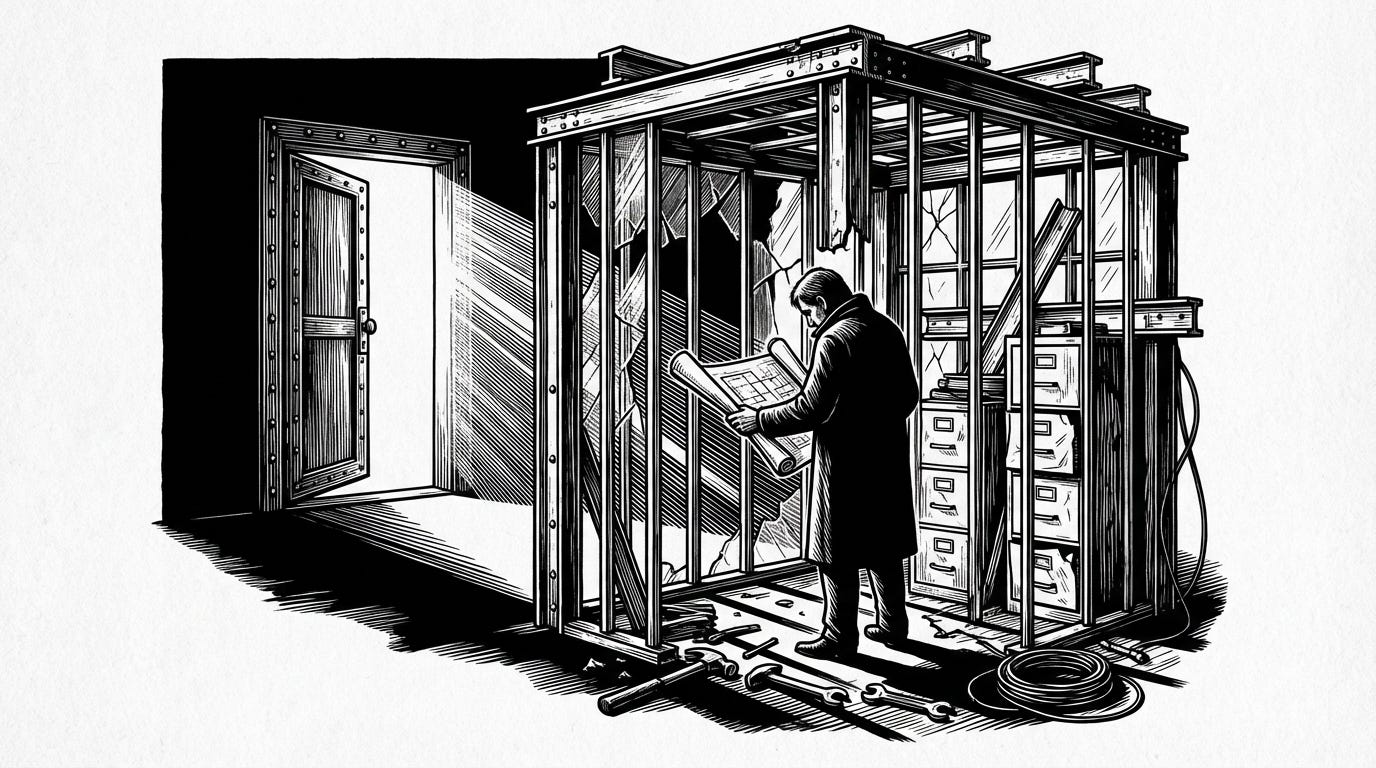
The line is so widely quoted that it risks losing its weight. But consider what it meant, coming from him. A man who had lost every external marker of identity - career, family, status, even his name - discovered that the space between what happens and what you do about it is the only territory that was ever yours. The title was a label printed by someone else. The role was a chair someone else placed. The identity you assembled across 15 years of corporate life was a scaffolding, not a skeleton. What remains, when all of it is stripped back, is the capacity to choose what comes next.
This is where the three threads meet.
The wrong summit is information. It shows you what you actually value by revealing what you don’t. The quiet betrayal, the slow drift of your values while your career stayed fixed, is what growth looks like within a system that wasn’t designed to grow with you. And the identity that keeps you locked in place, the one that makes leaving feel like self-annihilation, is a construction. You built it once. You can build it again.
Ibarra’s research on professional identity transitions found that people don’t change careers by figuring out who they really are and then acting. They act first and figure it out after. She calls them provisional selves, small experiments, side projects, and conversations with people living lives you’re curious about. The identity doesn’t arrive fully formed. It’s tested into existence. Ibarra studied investment bankers who became nonprofit directors, consultants who became teachers, and executives who became writers. Every one of them described the same thing: the old identity didn’t dissolve in a single moment of clarity. It loosened, gradually, as the new one proved it could hold weight.
You don’t need to quit your job on Monday. You don’t need a grand plan, a vision board, or a sabbatical you can’t afford. You need to stop treating dissatisfaction as a problem to be solved and start treating it as a signal to be read. What would you build if the identity you’re protecting didn’t need protecting?
Seneca, writing late in life after decades spent in the service of other men’s ambitions, offered a different frame:
”It is not that we dare not do things because they are difficult; it is that they are difficult because we dare not do them.”
The years ahead are not a consolation prize. They’re the canvas. But only if you stop painting by someone else’s numbers.
The trap was never the career. It was the belief that the career was you.
You built this once. You can build again. And the second time, you get to choose the blueprint.