
Your burnout is trying to tell you something
The recovery keeps failing because you're treating a signal as a symptom


Watch someone burning out. Not from the inside, where it feels like fog and heaviness and a slow greying of things that used to matter. From the outside.
They arrive at work on time. They hit their deadlines. They answer emails within the hour and show up prepared for meetings they didn’t need to attend. If you asked their manager, you’d hear “solid performer.” If you asked their partner, you’d hear something different.
They took a week off in October. Came back rested. By Wednesday, the rest was gone. They downloaded a meditation app in January; it lasted 11 days. They bought running shoes in March. The shoes are still by the door.
Every recovery attempt follows the same arc: relief, then return, then the slow bleed starts again. The pattern is so consistent that it almost looks like it was designed.
But nobody stops to ask the obvious question: if the recovery never holds, is the problem really what you’re recovering from? Or is it what you’re recovering into?
The word “burnout” entered clinical vocabulary in 1974, when psychologist Herbert Freudenberger noticed that the most dedicated volunteers at his free clinic were the ones collapsing. Not the disengaged ones. Not the ones phoning it in. The ones who cared the most. He described it as “the extinction of motivation or incentive, especially where one’s devotion to a cause or relationship fails to produce the desired results.”
That last clause is worth sitting with. Burnout doesn’t target the lazy. It targets the invested. The person who built their identity around competence, around being the one who delivers, around never being the bottleneck. The slow fade isn’t random. It follows the commitment.
Christina Maslach spent the next 4 decades mapping what Freudenberger had named. Her research identified 3 dimensions, and the sequence matters. First comes exhaustion; the obvious one, the one you notice. Then comes cynicism, a protective withdrawal from work that once engaged you. You stop caring about outcomes you used to care about. Not because you’ve lost interest. Because caring costs energy you no longer have, and your nervous system is rationing.
The third dimension is the one nobody talks about: reduced efficacy. You start doubting whether you were ever as good as people thought. The projects you delivered, the teams you built, the reputation you earned; all of it starts to feel accidental. Fraudulent, even. This isn’t impostor syndrome. It’s the final stage of a system that has been withdrawing more than it deposits; the brain quietly downgrading its own assessment of what it’s capable of.
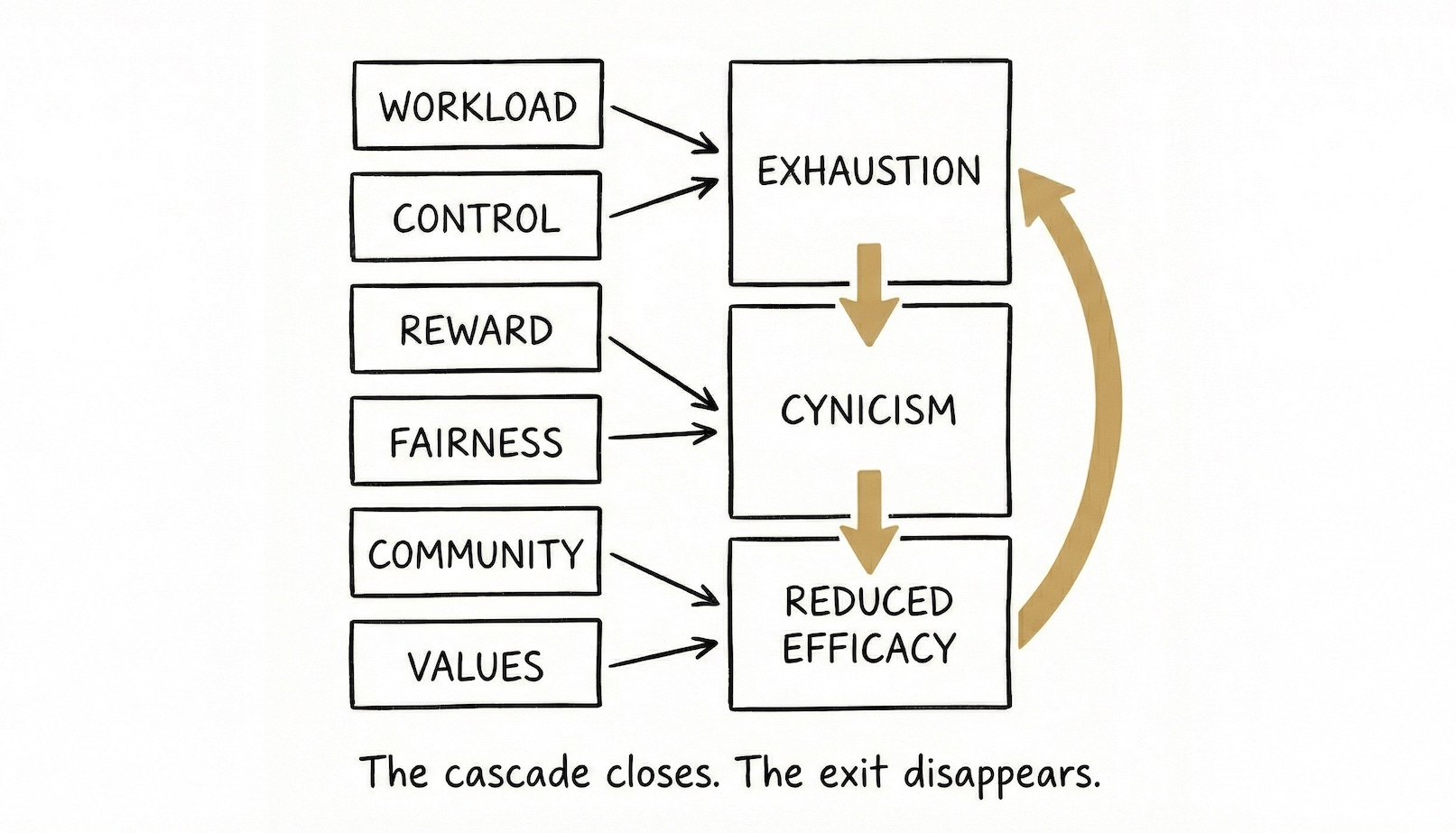
Maslach’s insight was that these 3 dimensions aren’t separate problems. They’re a cascade. Exhaustion triggers cynicism. Cynicism erodes efficacy. And reduced efficacy makes the exhaustion feel permanent, because if you were never that good to begin with, then recovery won’t restore anything worth restoring. The loop closes. The person inside it stops looking for exits.
Lisa Feldman Barrett’s research on the body budget confirms why: every cognitive demand is a metabolic withdrawal from a finite daily account. When the account runs dry, the brain doesn’t send a polite notification. It changes how you think, what you feel, and what you believe about yourself. The cynicism and self-doubt aren’t psychological weaknesses. They’re metabolic consequences.
So here is the picture that emerges: a high-performing professional, caught in a cascade they can’t see from inside it, interpreting a system failure as a personal one. And every conventional response reinforces the misdiagnosis.
So you take a holiday. You sleep. You go somewhere warm, leave your laptop at home, and read a novel for the first time in months. By day 3, the fog lifts. By day 5, you feel like yourself again. You think: I just needed a break.
You come back. Within 48 hours, the fog returns. Not because the holiday failed. Because you recovered and then walked back into the same architecture that depleted you. The same 7 am Slack messages. The same back-to-back meetings where you context-switch 6 times before lunch. The same manager who schedules “quick syncs” at 4:30 pm on Fridays. The same inbox that refills overnight like a tide you can’t outrun. You didn’t return to work. You returned to the conditions that broke you down in the first place.
The meditation app follows the same logic. So does the gym membership, the journaling habit, the Sunday meal prep that lasts 2 weeks. Each one treats you as the thing that needs fixing. Each one assumes the problem lives inside your head, your habits, your resilience. Push harder. Breathe deeper. Be more disciplined about rest.
But Maslach’s cascade doesn’t start inside you. It starts in the mismatch between a person and their environment. Workload, control, reward, community, fairness, values: she identified 6 domains where the mismatch occurs. Every self-care strategy in the world addresses the person. None of them touches the 6 domains.
You’ve been treating a fire alarm as a headache. Taking painkillers for the noise. The alarm is still ringing.
Seneca had an evening practice. Before sleep, he reviewed his entire day. Not with guilt. With curiosity. Where did I lose composure? Where did I give energy to something that didn’t deserve it? Where did the environment pull me off course? He called it taking account of himself. Not as punishment. As a diagnosis.
The practice only works if you treat your reactions as data. And this is the shift that reframes everything from the last 3 sections.
Maslach’s 6 domains: workload, control, reward, community, fairness, values, aren’t abstract categories. They’re signal channels. Your burnout is already telling you which ones are broken. The exhaustion points at workload or control. The cynicism points to reward or fairness. The self-doubt points at values or community. The cascade isn’t random. It’s specific. And specific means readable.
Your burnout is not a breakdown. It’s a diagnostic.
The fire alarm isn’t noise. It’s information. It’s telling you which room is burning. And the room is never “you.” The room is always a mismatch between who you are and the environment you’re operating in.
This is why the holiday didn’t hold. A holiday is a mute button. You silenced the alarm, rested your ears, and walked back into a building that was still on fire. The fog that returned within 48 hours wasn’t a relapse. It was the alarm picking up exactly where it left off, because nothing in the architecture had changed.
Marcus Aurelius made this operational 2,000 years ago:
“The first rule is to keep an untroubled spirit. The second is to look things in the face and know them for what they are.”
Not everything in Maslach’s 6 domains is yours to fix. You can’t redesign your organisation’s reward structure or rewrite its values from a middle-management desk. But you can identify which mismatches are within your control, and control is where the work begins. I recently wrote about the difference between self-control and system control: redesigning your environment so the right behaviour becomes the path of least resistance. The same principle applies here. Once you know which domain is burning, you stop trying to be tougher and start redesigning the architecture around it. Workload boundaries. How you protect your peak hours. What you say yes to. Who you surround yourself with. The signal tells you where. The environment tells you what to change.
Think back over the last 7 days. Not the calendar view; the felt view. Find the 3 moments where the signal was loudest.
The Wednesday afternoon where you sat in a leadership meeting and realised you hadn’t spoken in 20 minutes, not because you had nothing to say, but because you couldn’t summon the energy to care whether anyone heard it. The Friday standup where a direct report shared a win, and you felt nothing: no pride, no engagement, just a mechanical “well done” and a glance at the clock. The Sunday evening where you opened your laptop to prep for Monday, stared at the screen for 4 minutes, closed it, and told yourself you’d wake up early instead. You didn’t.
Now, map each moment to Maslach’s 6 domains. Was it workload? Control? Reward? Fairness? Community? Values? You don’t need to get it perfect. You need to get it specific. Because specific means actionable.
Then run the Friction Audit. For every mismatch you identified, ask: Can I redesign the environment around this, or am I trying to willpower my way through an architecture problem? The audit takes 15 minutes. The clarity it produces can restructure months.
Your burnout has been talking to you for a long time. You’ve been treating it as noise. It was always a signal.
Seneca, reviewing his day by lamplight, understood that the unexamined reaction is the most expensive one. The examined reaction is the beginning of architecture.
Stop medicating the alarm. Read it.
The fire alarm analogy is brilliant, is easy to blame the noise (the symptom) when the real threat is the heat (the environment). It’s a stark reminder that most of our 'self-care' habits are just ways to muffle the noise rather than putting out the fire. But the hard part is the “quick sync” meeting at 4:30 Friday noon, how to go around it? 😄