
The quiet death of human thinking
How to stay sharp in a world where thinking becomes optional.

I had lunch with a friend last week.
“I really enjoyed your essay on sleeping. I didn’t know that drinking coffee late in the day can lead to Alzheimer’s. And the bit about jet lag - I’m definitely trying that on my trip to the US next month. I’ll be honest with you, I don’t usually subscribe to newsletters. I get AI to summarise all my emails. But yours, I read in full.”
Then he tells me about his son.
“I can’t get my son off YouTube shorts and TikTok. Just social media in general. I told him to read a book but he won’t listen. It’s like talking to a brick. These kids, I tell you, I’m genuinely concerned about their attention span and the hours they’re glued to their devices. They can’t sit and be bored with their own thoughts for 5 minutes.”
Content creators have 3-4 seconds at the start of a video to grab your attention. If they don’t, the thumb keeps scrolling. Doesn’t matter how good the content is or how many hours they worked on it. That’s just how it works now.
4 seconds. It’s fucked.
Nothing effortful competes with cheap dopamine.
Add AI on top, and we’ve built the perfect world that trains the human brain not to be human.
I built an AI system to write my essays.
The perfect writing machine. Different agents working together, reference files with examples of writing, anti-AI patterns stripped out, per-platform voice, tone, and audience rules. It works beautifully.
And then, something happened.
It’s overcast as I write this. The sky is grey. Has been all week. Nothing outside has colour this time of year. Just the brown winter leaves being pushed around gently by the wind.
Cold shower. The smell of my second coffee is filling the room. Brain is wired and ready to fire.
Let’s begin.
THE STARS IN THE SKY
“The only true wisdom is in knowing you know nothing.” - Socrates
When you read a new fact, it lands on a tiny desk right behind your eyes. It’s a small desk that only holds four or five things. If you do nothing with it, it disappears. That’s normal - nobody remembers everything.
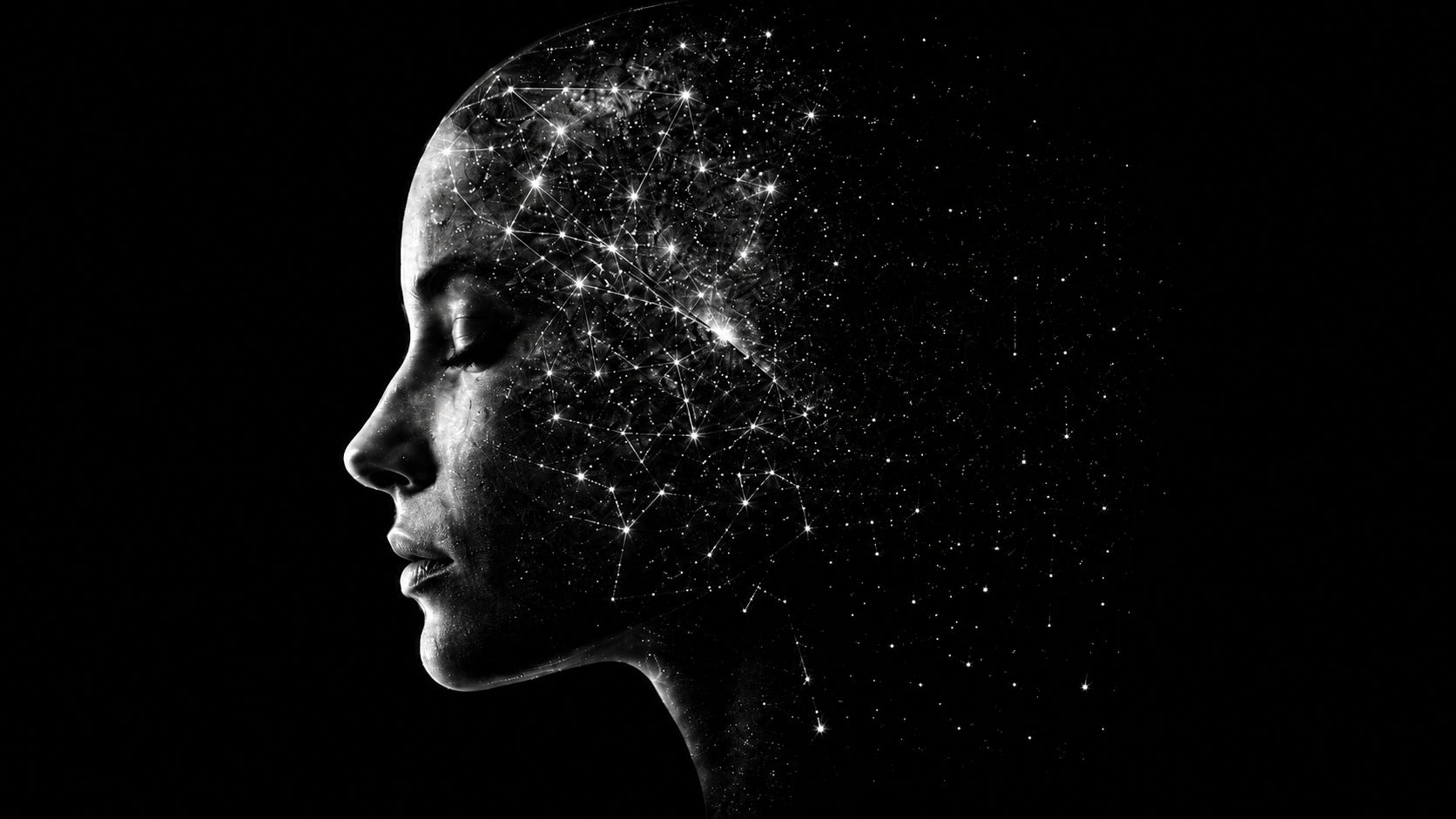
Now imagine the darkest night sky you’ve ever seen. Stars shining bright.
The survivors of the desk become stars in your brain. Call it your knowledge universe.
A new idea shows up as a new star. It doesn’t have anything attached to it yet. It floats and has no gravity. It’s lonely. A floating star with no gravity falls out of the sky by tomorrow.
So your brain goes looking for a match. It scans the sky asking where have I seen this before, what’s this like, what does this remind me of.
When it finds a star that fits, it throws a string across and ties the new one on.
This is called encoding.
That string is a connection, and the connection is a memory. Not the fact by itself - the fact plus the ties to everything else you know.
The more strings the star gets, the harder it is to lose.
Throwing the string takes a lot of effort and it can’t be rushed.
Reading a sentence or hearing someone explain it well only gets the star into the sky. It doesn’t tie anything.
The tying happens when you go away from the source and try to pull the idea out of your head.
This is called retrieval.
Say it out loud or write it in your own words. Use an example you made up. And notice where you stall.
The stalling is the whole point.
When you go blank or look for fancy words instead of a plain one, that’s not a fail - it’s your brain telling you which string didn’t take. Then you know what to fix instead of vaguely feeling like you “get it.”
If you can’t explain it to a 12-year-old in plain English (no jargon to hide behind), then you don’t know it. Go back and understand it better.
Sure, you’ve memorised the words, but you don’t understand it.
Knowing is different from understanding.
If you struggle to remember, that’s a good sign.
Your brain is a muscle. The strain is a rep. That’s when the tying actually happens.
Skip the strain and you skip the tie, no matter how many times you read the page.
When you do this enough with one idea, it stops being a lone star. A constellation grows around it, pulling on ten other ideas.
This is what understanding is.
Not one bright point, but a beautiful sky filled with interconnected stars.
Cramming stacks stars fast without any strings. The sky is bright for one night and empty by the weekend.
Real learning is slower on purpose.
People consume way more than they understand.
Modern society has a serious problem with “more, more, more.”
QUESTION WHAT YOU READ

Look at the headlines in recent times. “AI job cuts,” “100x yourself with AI,” “white collar jobs at risk,” “do more with AI.”
Everyone wants to point the finger at AI as the boogeyman.
It’s bullshit.
Then there’s a lot of talk about “judgement” and “taste.”
When AI creates a thing (document, code, image, whatever), a person doesn’t have to. Your job changes from doer to reviewer.
You assume the reviewer knows what “good looks like.” This “taste” comes from your unique lived experience - which AI can’t replicate - and your specific knowledge of that thing.
People are so fixated on how technology will out-skill us that they completely miss the ways that technology can de-skill us.
Which brings me to Sarah.
“I’m going to be late. MOVE!” It’s 8 am in peak-hour traffic. She’s stuck at an intersection. The traffic light just turned amber as she inches forward. Waiting for another green light. Again.
She’s a product manager at a big bank and mother of a 9-year-old daughter.
The bank signed a big deal with a major AI provider months ago. “Millions.”
Weekly emails flood her inbox with how-to guides on the new tech. She never reads them. No time.
Most people at the bank use it to draft emails, create documents and presentations. So does she. Everyone raves about their ‘productivity.’
She makes it to the office car park. On time.
“I need to get this presentation done ASAP.”
She’s presenting to her manager tomorrow. New features for the bank’s car loan mobile application.
Thanks to AI, she did the research and built the deck in 5 minutes.
Copy and paste never felt so good. Em-dashes and emojis everywhere.
At 11 am, she opens the presentation and reads the draft.
“This looks good!”
On to the next task on her to-do list.
THE ILLUSION OF LEARNING
“For most people, the tragedy won’t even feel like a tragedy. We’ll have lost the wisdom to feel nostalgia for what was lost.” - James Marriott
The illusion of learning, also called the illusion of competence, is when your brain mistakes reading for learning.
Reading is not learning.
Bypass learning and you bypass understanding.
MIT researchers split students into three groups and asked them to write an essay. Group one could use AI. Group two could use web search only. Group three could only use their brain.
The group that used AI?
83% couldn’t quote a line from what they ‘wrote’ just minutes earlier, and the whole group produced generic essays.
Their brains barely lit up on EEG scans.
Your brain is a muscle, and muscles must work or they get weak and small.
It’s called atrophy.
You can’t think and make connections between different pieces of information in your brain when you’re not exercising the muscle.
Remember the stars in the sky and the string? No reps = no string.
Then there’s timing. When young kids use AI, they don’t practice thinking at all.
What does this mean for kids and their brain development? What about their ability to think critically? What does it mean for teachers and the education system?
Neural connections may not develop as strongly if they outsource thinking too early.
This is the next generation that’s entering the workforce.
The trajectory looks cooked.
Critical thinking is vaporising before our eyes.
The Flynn Effect shows that IQ increased by about 3 points every decade over the 20th century.
That gravy train ended, and it’s trending down since 1990 in several datasets (now called the negative Flynn effect). Researchers reckon it’s caused by the environment because it happened too fast for it to be genetic.
You could argue that it started before AI.
TV → internet → social media → smartphone → streaming → AI
Poor attention and weak thinking.
That’s what the world is manufacturing. At scale.
Social media companies have perfected this.
Short-form video clips are exploding on every platform. They hijack attention perfectly by dialling psychological knobs with their algorithms.
Students even have trouble staying focused on a sonnet.
A sonnet is a poem that’s 14 lines long. 14.
In parts of the US, kids don’t even read a full book in high school. Thirty years ago, courses assigned 6-7 books per semester. Now it’s excerpts.
“College is just how well I can use ChatGPT at this point,” says a student from one study.
“Massive numbers of students are going to enter the workforce who are essentially illiterate,” says one college professor.
When the calculator was born, the world said it was the devil and everyone would get dumber.
But schools didn’t get rid of math. Kids still learned arithmetic alongside the tool, which made the tool safe.
AI is not going away. It makes you faster when you use it right.
But you must understand what you should and shouldn’t outsource.
Just because you can outsource everything to a machine doesn’t mean you should.
It’s 6 pm. Sarah is cooking spaghetti bolognese for dinner. Her grandmother’s recipe. The smell of pasta sauce fills the entire house.
Over at the kitchen table, her daughter is doing homework. ChatGPT is helping her write a short essay on whether pets should be allowed in the classroom.
Sarah walks over. “Tell me what your essay is about.”
Instead of answering, her daughter scrolls hastily, looking for the start of the essay.
“Hold on mum, let me just find where ChatGPT wrote it. I just asked it why cats drop hair everywhere. I know it’s here somewhere.”
Sarah thinks back to her own childhood. She didn’t have ChatGPT or the internet, just the library. She sat with pen, paper, and her imagination.
It took time. It was hard. But that was the point.
NOT THINKING ROTS YOUR BRAIN

It’s the start of a new semester, and Justin, a high school math teacher, starts his class.
“Kids, I’m running an experiment this semester. I want to see if using AI will affect you when learning math. So I’m splitting you into three groups. Group A, you can use ChatGPT when you study. Group B, you can use ChatGPT but only as a tutor. You can ask for hints but never for the answer. Group C, you can’t use AI at all - just use your brain. Old school.
At the end of the semester, you are going to write an exam. The group with the best scores will go to Disneyland, all expenses included. May the best team win!”
Here’s what happened: the kids who used GPT scored 48% better during practice but 17% worse than the group who didn’t use AI during a closed-book exam.
The GPT-tutor group kept most of the practice gains without the learning loss.
This was a real study that included about 1,000 high schoolers in Turkey.
The danger is not the machine. It’s you.
The path of least resistance is a terrible teacher.
Sarah is on the last slide of her presentation.
“What do you think of the new features?” she asks her manager.
“How will existing customers know they can offset their car loan? And what about home loan customers with their car loans at another bank? Can we pitch to them?” her manager asks.
Sarah’s heart starts racing. She can’t answer, but vaguely recalls seeing it in the deck.
She starts flipping through her presentation the same way her daughter scrolled through her essay the night before.
THE STRUGGLE IS THE POINT
I talked about writing before.
Writing is thinking.
You take an idea, you learn about it, you connect dots, you think about it, memories consolidate during sleep, then you write about it.
To get ideas, you must read. A lot. Read far and wide.
I’m not talking about 30-second cat videos.
Long-form. The stuff that needs attention.
If you made it this far into this essay, congratulations. You’re in the minority of people with a long attention span.
Reading and writing are the twin pillars of deep thinking. It’s like the serum a superhero takes to gain the superpower of deep thinking.
AI is the latest in a long line of technologies fighting your ability to think for yourself.
And it’s coming fast.
The antidote is to use time under tension.
Time under tension is a concept in weight training.
Imagine doing a squat with weights on your back. You can do a 3-second squat or a 10-second squat. That duration is the time your muscles are under tension.
If you’ve ever done slow reps, you know that 10 seconds is agony.
But slow reps build more muscle. It’s hard. It hurts. That’s the point.
Put your brain under tension to make it stronger.
There’s this thing I call the hallucination trap.
Bypass the learning process, and your brain doesn’t build the habit of understanding.
Learning a hard topic through a large language model (LLM) will always be hard.
You never develop the skill and thought patterns needed to organise it for yourself.
Then the thing hallucinates (which is a feature, not a bug).
LLMs use a probability network. It predicts the highest-probability word that comes next in a sequence, based on its training data. That’s just how it works.
They are not connected to some universal truth machine. It just predicts.
If you don’t have knowledge and understanding, you have no idea whether its response is true. You take it as fact when it’s “confidently wrong.”
You don’t even know what good questions to ask.
But when you have knowledge, you can ask better questions.
You can give specific prompts because you know the subject. You can give context.
Your outputs will be vastly better than someone who doesn’t know which questions to ask.
People who complain about the outputs they get from LLMs don’t understand this concept.
The models are fine. The context, instructions you give, and questions they ask are not.
Here’s the irony: LLMs don’t make expertise LESS important.
It actually makes it clearer when someone does or doesn’t have the expertise because it’s so easy to get a middle-of-the-road generic answer.
Think about that.
Back at Sarah’s kitchen table, it’s the day after her presentation.
Her daughter has her math book open. No devices in sight.
“Muuuum. This is hard! I need ChatGPT to help me! Muuum!”
Sarah doesn’t respond. She made a new rule: homework without ChatGPT.
THE STAKES
What if the whole problem with AI and it reducing your intelligence is only a problem right now?
Fast forward one year from now. GPT 15 or Claude 15 or whatever the flavour of the month is comes out.
What if it’s so good that it gives you the truth and factual information, all perfectly organised?
Maybe you don’t need expertise to use it properly. You can just give it a shitty, vague prompt, and it will give you the perfect result.
Maybe the ability to do deeper thinking isn’t needed anymore.
If AI keeps developing as it has been, it will become the opposite. The better the machine gets, the more your own thinking is worth.
30 years ago, we all wrote on our resumes: “Proficient in Microsoft Word, Excel, and Powerpoint.”
Today, it’s a given.
Imagine you’re interviewing someone for a job and they tell you, “I don’t know how to use Google search.”
You probably won’t hire them. But 30 years ago, that was common.
It used to be impressive to use the internet well. Now it’s a given.
It used to be impressive to have a university degree. Now a degree is just the beginning for many professionals.
How much someone is willing to pay you depends on how much value they think you can provide.
If AI can already provide a lot of value, why would someone pay you?
The level of expertise you must bring to the table becomes even higher.
That’s the impact AI is already having on the professional world.
To be competitive, you can’t just know how to use AI to access information. Anyone can do that.
You need to know how you can use AI to develop real expertise. That means using your brain.
When you walk into a room, you must be able to create a higher quality result than someone else.
SATURDAY NIGHT, 11:17 PM

I’m sitting at my computer, talking to Claude. I’m usually in bed before 9 pm. It’s been after 11 every night this week. I’ve been doing this for months. Late nights. Wide awake at 2 am because I can’t switch off my brain. Too many open loops.
My Whoop notifications are screaming at me. One red recovery day after the next.
Just one more prompt.
I’m ‘writing’ my newsletter article for next week.
“Claude, rewrite the fourth paragraph. I don’t like the reference to the gravel road; find another analogy. And verify the number you quoted. Give me the full piece when you’re done.”
I start reading the draft.
Two sentences in, and I realise that I have no idea what the core argument of the piece is.
Zero.
I couldn’t say it in my own words.
I don’t even remember what the previous article was about.
What the fuck? Am I just tired?
Right then, in that moment, I felt what I was doing to my thinking.
I’ve been so consumed with my new superpower that I never thought about the consequences. I’m not thinking for myself anymore.
I turned off the screen and went to bed.
When I woke up the next morning, I quit.
I made a decision. Claude is not writing for me anymore. I need to go back to basics and use the muscle in my skull for what it was made for.
I ordered physical books on writing well, storytelling, and attention mechanics.
The checkout page recommended highlighters and pens, so I bought those too. For scribbling in the books.
I genuinely enjoy writing. School taught me how to read and write. But it never taught me to write well.
Why would you buy a book on writing if you’ve been writing for most of your life? Because you should never assume you know everything. Use a beginner’s mindset.
Writing is a skill, and skills can be learned. And I want to learn.
I’m not good at it, but I’m doing the reps. Writing these words is just another rep.
You learn by doing.
Sure, I can pump out 5 essays a day with AI. But it defeats the purpose of what I want my brain to do.
What I need my brain to do.
HOW TO TRAIN YOURSELF
“I hear and I forget. I see and I remember. I do and I understand.” - Confucius
When you work on something that feels like a lot of effort, that’s your brain starting the process of learning.
That’s your signal.
Do NOT outsource this part (known as cognitive offloading).
Figure it out. Yes, it will take longer, but that’s the point.
Get the reps in, build the muscle.
If you’ve outsourced your thinking for a while, this will be hard at first, but it can be learned.
Keep practising.
Think of AI as an assistant and not your brain.
Here are 5 ways to do that:
1. Use AI as a tutor
Example prompt:
“You are a tutor. Your job is to help me understand [topic] in plain English. No jargon. Start by asking me 3 questions about the topic to test what I already know. Do not give me the answer. Teach me the concepts like I’m a 12-year-old and use first principles thinking. Do not make things up and cite your sources.”
2. Use AI to research the web
This is one of the best use cases for agents. It saves you hours of clicking.
Agents can crawl the web for topics you’re interested in across all media like YouTube, podcasts, articles, and forums. Another agent can find contradictions, fact-check claims, and give you a synthesised report.
Use this as your starting point.
Then you go down rabbit holes, learn new things, and start connecting ideas in your head.
Stars and string, remember?
3. Use AI as a sounding board
I do this often.
When I have an idea that I’ve researched, I stress test it with a group of agents. Think of it as getting peer feedback on a document you wrote.
They are critic agents. Great for finding ‘confidently wrong’ information.
Example prompt:
“Spawn a team of adversarial sub-agents: one first principles thinker, one systems thinker, one incentive realist, and one pre-mortem adversary. Have them attack my idea and rip it apart. Don’t be nice. Show me angles I didn’t think of to make my idea stronger. No fluff, no jargon. Brevity matters.”
Use the output to build the big picture yourself. Use pen and paper. Draw lines. Make it messy.
Messy is the thinking.
When you build the knowledge, guess what? You start asking better questions. You prompt better. You get better outputs.
4. Create AI personas
Another way I use this is to give agents personas.
If you have a question about something, who would you ask for help?
For example, if I want to start an online business but have no idea what to do, I’ll create a co-founder who builds online solopreneur businesses.
A co-founder knows about funnels, marketing, selling, pricing. You can build personas for different areas in your business.
By doing this, you point the LLM to a specific slice of its training data. It’s like speaking to an expert. Much better outputs.
But the same rules apply - you still need to understand what you’re asking about.
5. Use AI to review
I have an editor agent. When I finish writing an essay, I’ll get my editor to review it for good prose. I tell it what ‘good looks like’ by giving it rules. Styles I like. Active voice. Plain words.
The editor can only give advice and never writes.
I ignore half of it and use what I think will benefit the reader. I write it in my own words.
In my mind, I imagine the editor taking a red pen and scribbling all over my essay.
I’m not against AI. Quite the opposite. I’d call myself a heavy user.
I spend hundreds of dollars a month on AI subscriptions. Some on ‘max’ plans.
I’ve built websites, a learning programme, payment integrations, automations, and more.
I built an agent that does my grocery shopping because I’d rather spend that time reading or writing.
These are things I couldn’t do before.
You run on the same hardware as our ancestors. A brain is still a muscle.
Somewhere along the way, you stopped doing the simple things needed to keep growing as a human. To level up.
Read (long-form). Write. Learn. Be curious. Question things. Look for answers. Exercise. Socialise. Figure things out the hard way. Do the reps.
Train humans to be human again.
My essays are rougher now and take longer, but my brain is banking the reps.
My friend is still trying to convince his son to open a book.
P.S. Thanks for reading. Subscribe if you enjoyed this. I write about personal growth, philosophy, and tech. And I care about the person running ancient hardware in a modern world.
I built a self-paced programme to help modern professionals. It’s called The Refactor.
If you feel stuck, running on fumes, or spending every minute of your life working, check it out. It’s not some productivity rah-rah nonsense. Practical advice, grounded in science. I use the same practices daily, and I want to give them to you.
Check it out here.