
Caffeine is aging you 15 years (the sleep science no one talks about)
Everything is downstream of sleep. Fix your sleep and change your life.


Sleep makes you blind, deaf, paralysed, and defenseless.
It’s the single worst survival strategy imaginable, yet it survived 600 million years of evolution that deletes anything useless.
Sleep is older than your species.
Picture your earliest ancestor in a shallow cave, thousands of years before agriculture, fire, or a house.
Every predator in that world hunted best at night, and every night that ancestor lay down, closed their eyes, and went unconscious anyway.
Not for a minute. For hours.
Blind. Deaf to half of what’s happening. Paralysed in the deepest stage.
Sleep is, on paper, the single worst survival strategy a species could adopt.
The only explanation is that whatever sleep is doing is so essential that every alternative strategy was worse.
Understanding the structure of sleep - its architecture - is the first step toward protecting it.
Because you will spend roughly a third of your life asleep.
Most people treat sleep like a rounding error. The first thing to cut when the week gets busy.
Evolution disagrees, and evolution has had 600 million years to check its work.
I wear a sleep tracker (4+ years) and logged 1,500+ nights to find out what evolution already knew.
Most of it isn’t what you’ve been told.
I - Sleep is a renovation crew
Sleep is recovery.
Somewhere inside a hospital, a person is lying perfectly still with wires taped to their scalp. They look like they’re doing nothing.
Their brain is busier than yours while you read this.
Almost everybody thinks sleep is an off switch.
You flip it down at night, flip it up in the morning, and nothing happens in between except time passing.
Sleep is a night shift, not an off switch.
Imagine a football stadium after the final whistle.
Ninety thousand people go home. The lights go half-dark.
And then - around midnight - the cleaning crews arrive.
They repaint the lines. They fix the seat that broke in the third quarter. They clear out thirty tonnes of rubbish nobody wants to think about.
Nobody watches this crew. Nobody claps.
But if they skipped a single night, you’d notice immediately the next morning. Sticky floors, missing lines, full bins, and a stadium that doesn’t work.
Your brain runs that exact crew, every night.
Here’s what happens.
Crew one: the cleaners. When you’re awake, your brain cells burn fuel which makes waste. Tiny bits of protein junk. Deep sleep clears this junk, like a street sweeper after a parade (known as the glymphatic system).
Crew two: the filing clerks. Everything you learned today got dumped onto a small desk. It filled up fast. During sleep, your brain picks up those memories one by one, decides what to keep, and saves the keepers in long-term storage.
Crew three: the builders. Most of your growth hormone gets released during deep sleep. Your muscles repair, bones lengthen, wounds start healing.
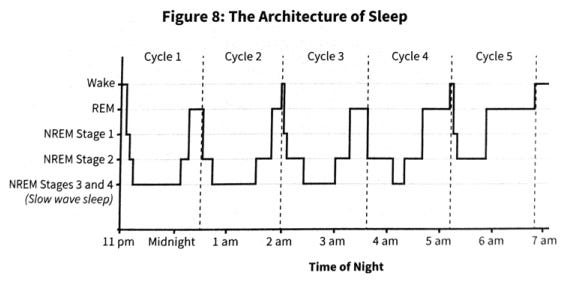
Sleep isn’t one thing. It’s a loop you ride about five times a night. Each loop lasts roughly 90 minutes and carries you through four stages.
Stage 1 (N1): the transition stage between being awake and falling asleep, also known as light sleep.
Stage 2 (N2): a deeper light sleep where the body relaxes, temperature drops, heart rate slows, blood pressure drops, and brain waves slow down. N2 is critical for memory consolidation.
Stage 3 (N3+4 / Deep sleep): the restoration stage, critical for tissue repair, immune support, and hormone regulation. Crew one works here. The toxins they remove prevent Alzheimer’s disease.
Alcohol destroys deep sleep.
You might fall asleep faster after a few drinks, but you’re trading the cleaning crew’s ability to do their job and your sleep quality suffers.
REM sleep: Rapid Eye Movement (REM) sleep is where vivid dreams happen and where your brain processes what happened emotionally. Call it overnight therapy. Your body is in temporary muscle paralysis to prevent acting out dreams.
Neuroplasticity is how your brain rewires itself through repetition.
Sleep is where you press the save button on the reps.
So who tells this crew when to show up?
It turns out you’ve got a clock for that, and it’s not one with numbers.
II - The clocks no one told you about
You have a clock inside your brain.
Not a clock with numbers - it’s made of cells, and sits roughly behind your eyes. Its whole job is to answer one question, over and over, all day long:
Is it bright or dark outside?
That tiny clock doesn’t check a calendar or a phone. It checks light.
Your eyes are wired straight to it, like a hallway with a direct line to the control room.
Bright light comes in, the control room says “daytime, stay sharp.” When light fades, it says “nighttime, wind down.”
Here’s what happens when it says “wind down.”
Your brain sends out a chemical called melatonin.
Melatonin is like a text message, not a punch in the face. It doesn’t knock you out.
It just taps your body on the shoulder and says: hey, it’s night now, you should start getting sleepy.
Melatonin does not make you sleep. It’s a messenger, not a sedative.
Melatonin has a partner that does the opposite job, and it’s called cortisol.
Cortisol is a text that says “wake up, get moving, be alert.”
Cortisol rises sharply in the morning, usually 30-45 minutes after you wake up, not straight away.
Picture a seesaw. Cortisol on one end, melatonin on the other.
All day long, as one goes up, the other comes down.
Morning: cortisol is high, melatonin is basically zero - you’re alert. Evening: as light fades, cortisol starts dropping, melatonin starts climbing - you get sleepy. They’re never both high at the same time.
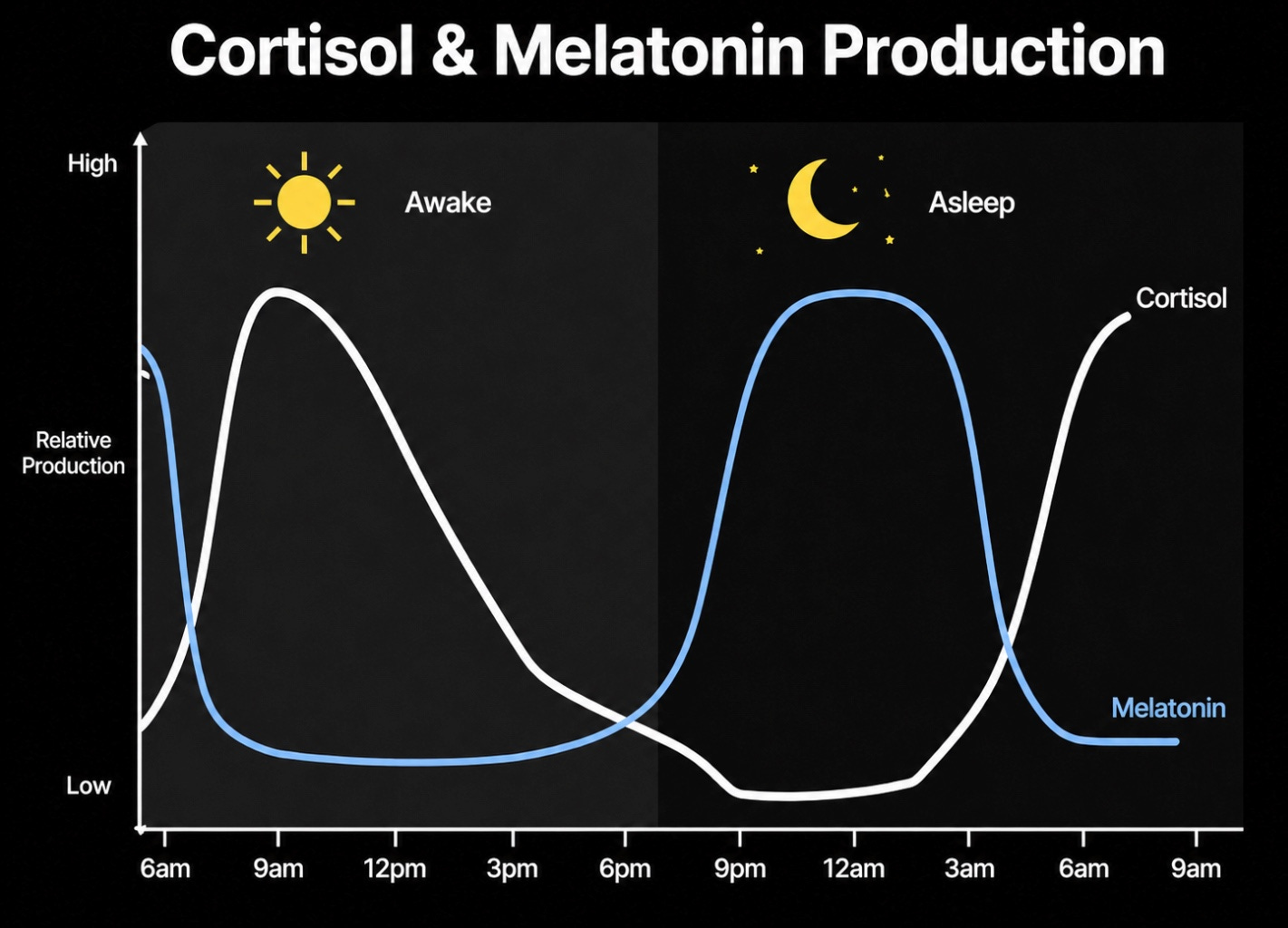
The clock behind your eyes is the hand pushing the seesaw using light as a signal for which way to push.
There’s a second system running at the same time, and it doesn’t care about light at all. Think of it as an hourglass.
It only cares about one thing: how long have you been awake?
Every hour you’re awake, your brain produces a chemical called adenosine, and it just piles up.
Picture a jar in your head that fills, one scoop at a time for every hour you’re awake. Wake up at 7 am, and the jar is empty. By 7 pm, the jar’s got twelve hours of scoops sitting in it.
The fuller the jar gets, the more tired you feel. That tired, sludgy feeling at the end of a long day is adenosine, piling up in your brain. Sleep empties it back to zero.
All of this is your circadian rhythm.
I love coffee. There’s a strong brew next to me on my desk as I’m writing this. Hyperfocused.
Caffeine doesn’t add energy.
It doesn’t touch cortisol, melatonin, or care about the light-clock at all.
Caffeine is a trickster: its molecule happens to be shaped just enough like adenosine that it can wedge itself into the same sockets in your brain adenosine normally plugs into. Like jamming a fake key into a lock so the real one can’t get in. The fake one just blocks the slot.
When you drink coffee, adenosine is still piling up in the jar, hour by hour. Caffeine hasn’t stopped that. It just blocked your brain from reading how full the jar is.
The wall of exhaustion you feel when your coffee wears off (a caffeine crash) is the fake key removed from the lock, and your brain reading how full the jar is.
Caffeine hangs around in your body for a long time. After about 5-6 hours, half of the caffeine from your coffee is still in you.
Caffeine late in the day disrupts your sleep quality by up to 30%. Specifically, deep sleep.
You have to be 15 years older than you are now to decrease your deep sleep by that much. Think about that.
You can drink coffee, go to sleep, and think that you sleep fine, but your sleep quality will be cooked.
Look up to the sky, and pretend you see the International Space Station (ISS) flying by.
It travels at an average speed of 28,000 km/h (17,500 mph).
Astronauts up there see a sunrise roughly every 90 minutes. That’s 16 a day. 16!
Their bodies have no real “night” to anchor to, so they run on artificial schedules, split into shifts. They deliberately manipulate light exposure to keep their internal clocks from drifting into chaos.
The light you get in the first 30-40 minutes after waking has a massive influence on our circadian rhythm.
Getting outdoor light first thing in the morning is preferred because it’s ten times brighter than anything indoors (even under a grey sky).
If it’s still dark when you wake up, turn on all the lights to send a signal to your body that you’re awake.
Your circadian rhythm is about reading light. And if it’s about reading light, you can manipulate it.
Yes, you can bend it.
And there’s a very specific use case for it in modern life.
What you can’t bend is which type of clock you were born with.
III - Night owl, early bird, neither
Ever wondered how some people are hyperactive first thing in the morning, but you can barely string a sentence together? Or how your energy fades after lunch when others are pumping out a new company strategy on a whiteboard?
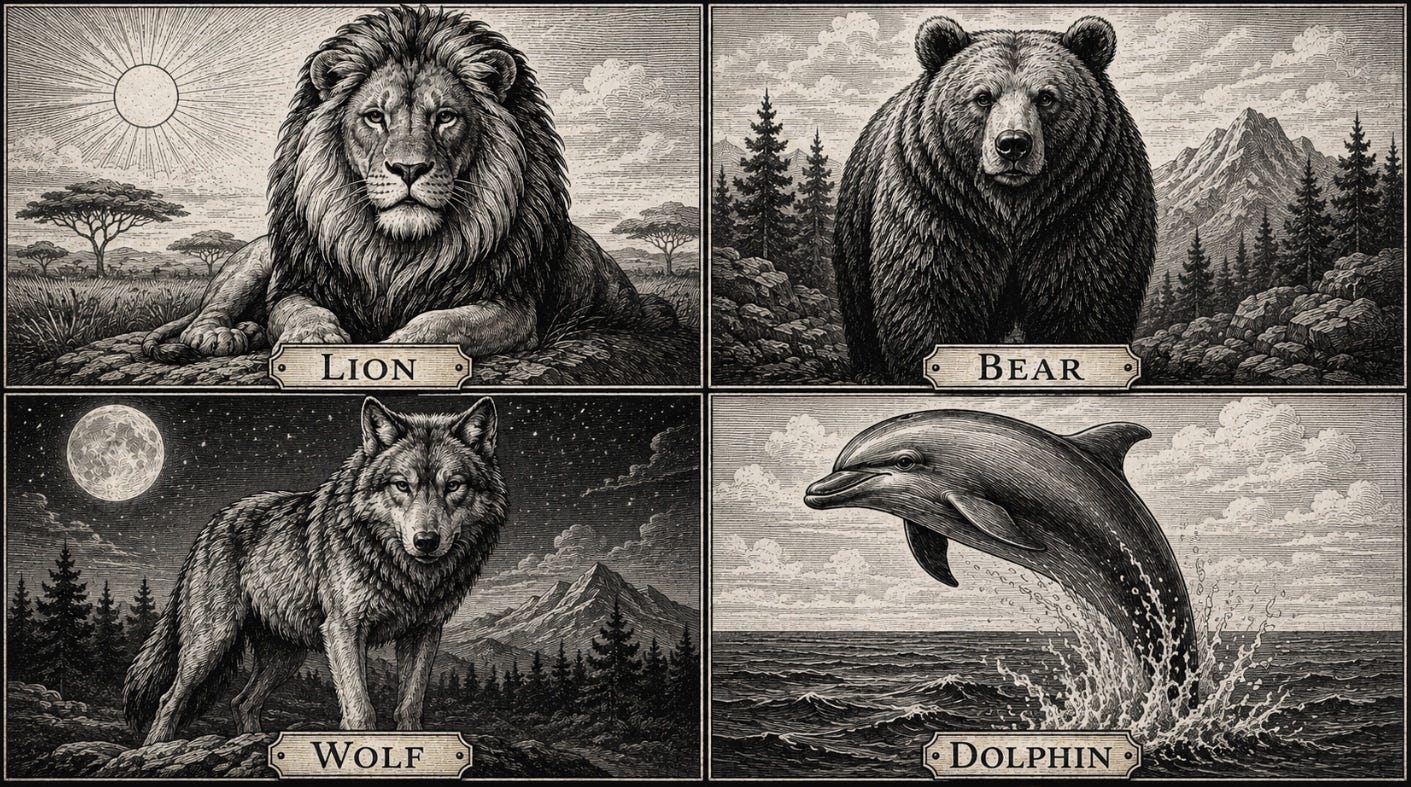
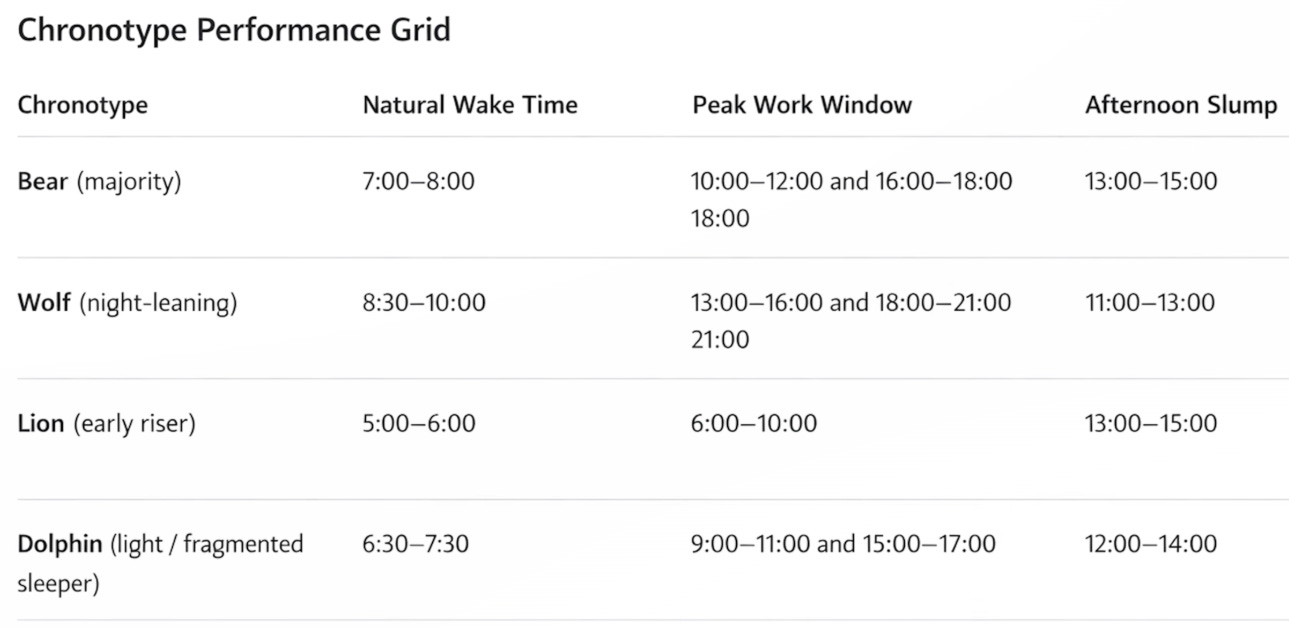
Because, my friend, you are genetically wired to be one of four chronotypes.
Lions - early risers (5-6 am), sharp through the mid-morning, running out of steam by afternoon (this is me).
Bears - most people, roughly follow the sun, wake up around 7-8 am, hit a slump in the early afternoon.
Wolves - the night owls, slow to start in the morning, waking closer to 8:30 - 10 am, hitting their best thinking in the evening.
Dolphins - light, fragmented, wired and alert but never fully settled, smaller “good” windows during the day.
You don’t get to pick your chronotype. It’s built into your genes.
It varies during adolescence (which is why teenagers sleep so much), settles for most of your adulthood, then changes again later in life.
Which is why your elderly parents or grandparents are wide awake at 4 am without even trying.
Modern life doesn’t give a fuck about your chronotype. 9-5 jobs exist to make money. Bears suit that schedule perfectly.
To perform at your peak performance, build your day around your chronotype.
For example, mornings are my peak. I fiercely block my calendar and protect that time for deep work. The middle of my day is left open for meetings. Admin work lives in the afternoon because I don’t have much brain power left in the afternoons.
If someone schedules a strategy session with me at 4 pm on a Friday, they’ll get about 10% of me. It’s just biology.
One study looked at students who wrote exams at their cognitive peak based on their chronotype (earlier in the day or later in the day). Unsurprisingly, they performed better (faster response times, memory recall, etc.). Morning types outperformed evening types.
No one teaches you this stuff.
I will show you exactly how to use your chronotype to your advantage.
IV - Free doping
Sleep is the single most powerful performance enhancer.
Walk into any conversation about performance and you’ll hear the same words: magnesium, ashwagandha, a $400 pillow, and a supplement stack that costs more than rent.
Everyone is looking for an edge.
Here’s the edge, already sitting in your house and costing you nothing: sleep.
It’s legal, free, and yours every night you choose to use it properly.
Everything downstream of sleep gets better when sleep gets better.
Everything.
You wake up feeling rested and you’re in a better mood. Reaction time, decision-making, glucose regulation, immune function, mood, strength gains, memory, all benefit.
NASA tested naps on long-haul pilots and found that a 26-minute nap improved their tasks by 34% and alertness by 54%. Keep it before 3 pm and under 30 minutes, or you’ll dig into the same night’s sleep pressure you are trying to protect.
Athletes who extend their sleep post faster sprint times and better shooting accuracy in controlled studies, without changing a thing about their training.
Sadly, most people will spend money chasing a supplement before educating themselves and fixing their sleep setup.
Think about how seriously athletes treat their equipment.
A runner won’t lace the wrong shoes. A cyclist obsesses over the bike, the fit, the clothing. Nobody questions that spend.
But ask the same person what pillow they sleep on, what’s in their mattress, what sheets they use for temperature regulation, and you get a shrug.
If your equipment sucks, no amount of hustle fixes the outcome.
Fix the equipment first before you spend a cent on supplements.
A runner doesn’t guess which shoes are fast. They test, they track, and they figure it out until they know.
Here’s what tracking my own sleep taught me.
V - 1,500 nights
A plane needs runway to land.
I’ve worn a sleep tracker for 4+ years.
That’s over 1,500 recorded nights: caffeine timing, alcohol, workouts, stress, travel, all of it, cross-referenced against my recovery.
My tracker app has a journal feature that asks me a bunch of questions the next morning about what I did the day before.
Over time, you see which things affect your sleep in a good and bad way. Changing my sleep behaviour has been the single biggest impact my Whoop has had on me.
The top behaviours that improve my sleep: going to bed and waking up at the same time (sleep consistency), no coffee late in the day, no meals close to bedtime, easy exercise (where you can just about hold a conversation), drinking enough water.
Before I dug into my sleep, I never cared about when I ate my last meal of the day. I never even thought about it.
When you eat late or close to bedtime, your body doesn’t have time to digest your food. Your heart rate rises to send blood to your digestive system. Blood sugar levels change.
Digestion raises your body temperature slightly.
Your body wants the opposite in the first few hours of sleep: low heart rate, low body temperature.
I go to bed early and wake up early. So I have my last meal of the day ridiculously early (about 3 hours before bed on a perfect day).
When I travel for work and can’t avoid a late dinner, I sleep like shit and my tracker confirms it. Every single time.
You need runway to land a plane. You need the same before bed.
Three hours before sleep: stop eating, stop drinking fluids in volume, and let your body finish what it’s doing.
Sugar close to bedtime spikes insulin, which messes up your circadian rhythm because your brain can’t produce as much melatonin.
Maybe think twice before eating that dessert.
You want to be relaxed as you wind down for bed. Breath work or meditation.
This helps to reduce your heart rate. Try 4-7-8 breathing: in through the nose for 4 counts, hold for 7, out through the mouth for 8. Aim for 20 cycles.
The military uses 4-7-8 breathing to help soldiers in high-stress situations to calm the nervous system.
If 4-7-8 is too hard, try 4-5-6 (or shorter), then work your way up.
If you fix nothing else, fix this: sleep in a cool room. Your body temperature has to drop for you to fall asleep. It’s a biological trigger.
Cool the room, use breathable sheets, and if you’re serious, a cooling mattress pad - or something as simple as frozen water bottles in socks when you’re travelling - will outperform almost anything else for the effort involved.
I’ve been using a cooling mattress cover for the past year. I fall asleep faster, no more sweating in the night, and I miss it when I travel.
A warm shower or bath 60-90 minutes before bed also helps. It sounds counterintuitive, but the warm water pulls blood toward the surface of your skin.
When you step into a cooler room, the heat radiates off fast, dragging your body temperature down faster than it would have on its own.
Warm shower, cool room, bed, in that order.
Clocks didn’t become popular until the 1600s. What a time to be alive.
Time was the sun, roughly. Once clocks became common, humans started obeying the clock more than something they “felt.”
Humans are the only animals keeping time. Birds aren’t late. A dog doesn’t check its watch. Deer don’t fret over passing birthdays.
Man alone measures time. And we have a fear of time running out.
But I digress...
Your phone buzzes, lights up, and pulls your attention every five minutes, right until you try to sleep.
But you can’t. Because you’re wired.
The fix is simple: charge your phone in a different room.
Do not look at the time when you wake up in the middle of the night.
You can nail all of this and still lie there wide awake the night before something big.
An interview. A meeting. A deadline. A flight.
It’s called anticipatory anxiety.
It’s when your body treats tomorrow’s stress like it’s already happening, flooding you with the same fight-or-flight chemicals a soldier gets before combat.
Tired, but wired.
Fixing your room is the easy half. The other half is what’s running in your head when the lights go off.
VI - Your job doesn’t clock out anymore
150 years ago, most of the world didn’t go to an office.
They farmed. Before industrialisation, 8-9 out of every 10 people on Earth lived or worked on a farm.
Farming ran on one clock: the sun. The same light-clock from earlier. You stopped farming when it got dark.
Then came the factory. A whistle when the shift was over instead of a sunset. You clocked out at 5 pm, and work had no way to reach you until you clocked back in the next morning.
Today, you don’t have the sun or a whistle.
Work finishes when you decide it finishes.
Thanks to your phone, laptop, and the internet, you can keep going. Companies will happily take every hour you’re willing to give them.
The numbers back it up: most people say heavy workloads hurt their sleep. In one survey, over 70% of people admit calling in sick because they were too tired to function after a bad night (researchers call it snooze days).
You can’t single-handedly redesign your company culture. But you can redesign your own boundaries.
Do not work in bed.
There’s this thing called conditioned arousal where your brain has learned to associate your bedroom with being awake instead of being asleep.
If you work in bed, have a TV in your bedroom, or eat in bed, your brain links your bedroom to those activities, along with being alert and stressed. The exact opposite of what you need at 11 pm. Avoid them at all cost.
Only use your bed for sleep and sex.
The environment should signal “time to sleep,” not “time to be awake.”
I wrote about the importance of your environment previously. >>>link to neuroplasticity piece <<<<
Use sleep as a weapon and create boundaries. You’re the only one that suffers if you don’t.
Boundaries can protect you at home, but they can’t protect you from crossing time zones.
But even that has a fix.
VII - Jetlag is a math problem
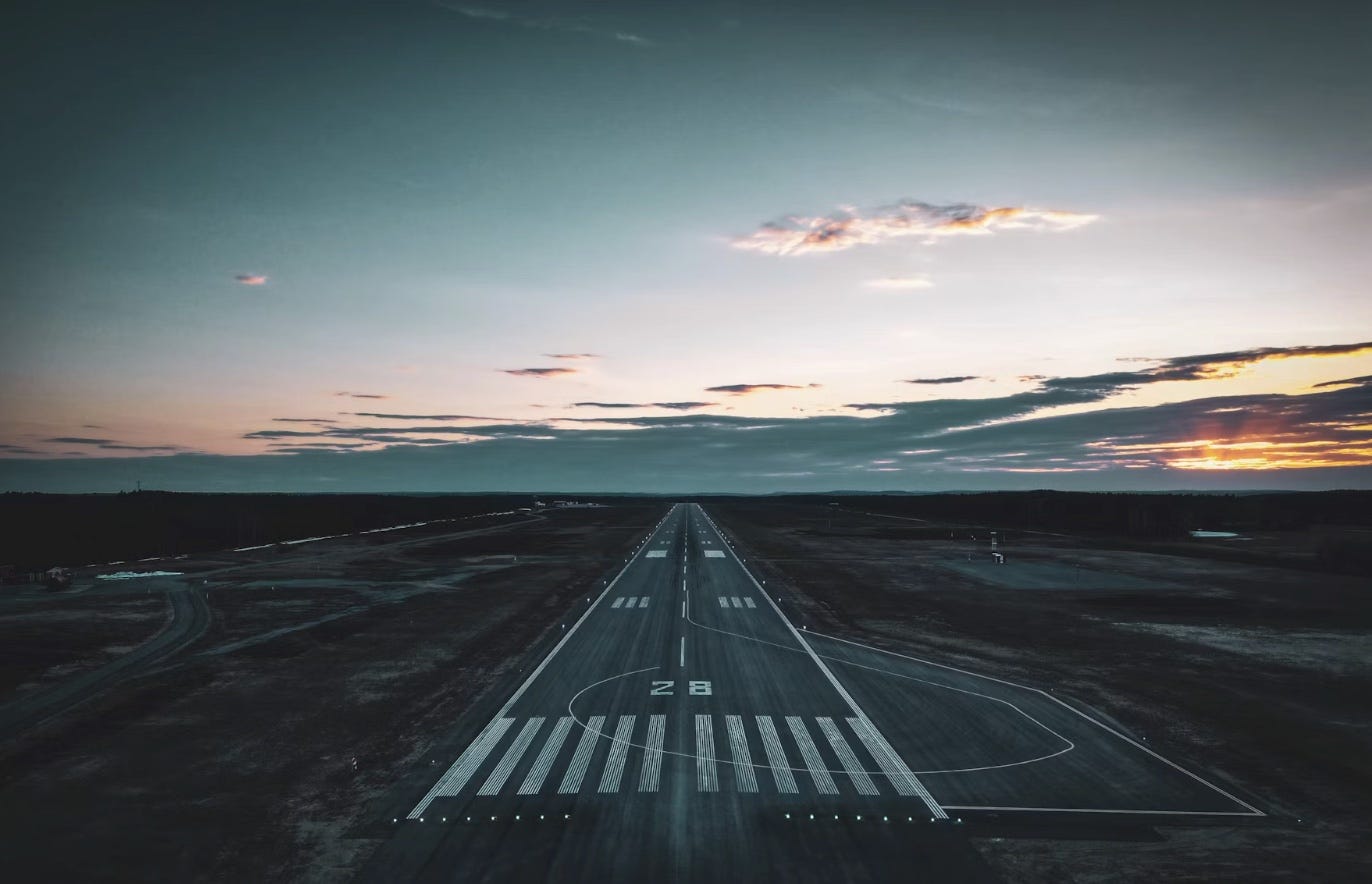
Jetlag sucks and feels like a mystery.
Turns out it’s not.
When your plan lands, your circadian clock is still running on the old time zone’s light schedule.
The fix: control when you get bright light, when you eat, and when you take melatonin. You can push or pull your clock in the direction you need faster than your body would on its own.
There’s an app for it called Timeshifter, and it uses the exact science that NASA uses for astronauts on the ISS. Remember the 16 sunrises and sunsets per day?
You give the app your flight numbers and typical sleep schedule, and it tells you when to get light, when to take caffeine to stay awake, when to take melatonin to signal sleep. I’ve used it many times and it works exceptionally well.
There’s a second piece to the puzzle called ‘the first-night effect.’
When you sleep in a brand new place for the first time, part of your brain stays semi-alert all night. Even in a comfortable hotel bed, and even if you’re exhausted.
It’s an evolutionary protection mechanism. Your ancestors sleeping in unfamiliar places for the first time couldn’t afford to go fully unconscious, so part of their brain stayed on watch.
You’re running the same software in a Marriott.
Night one usually sucks. By night two or three, you’re good to go.
Some people wake up exhausted every single day of their life and never find out why.
VIII - The disease more common than diabetes
About 590 million people suffer from diabetes (~11% of people).
Most people know what diabetes is and get it treated.
Did you know that more people suffer from sleep apnea (936 million)? And the vast majority remain undiagnosed. Over 14% of adults worldwide have it. Up to 90% don’t know it.
Sleep apnea is when your airway partially or fully collapses repeatedly during the night. It cuts off your breathing for a few seconds, hundreds of times a night - without you fully waking up to register it.
You wake up exhausted and have no idea why.
People with untreated sleep apnea have a much higher risk of developing Alzheimer’s disease later in life.
It’s tied to the cleaning crew from section I. When deep sleep is interrupted, the cleaning crew can’t clear the protein junk. Night after night, for years.
Aside from apnea, people who consistently sleep under six hours a night have a higher risk of dying from any cause at all (not one specific disease). At a population level.
Here’s the kicker.
Across medical school curricula, doctors receive on average just over an hour of formal education on sleep. For something that consumes a third of every patient’s life.
Let that sink in.
In a global study of 30,000 people, 80% said sleep was important to their health, yet fewer than 30% actually sleep well every night. Fewer than 25% saw a medical professional about it.
Stress and anxiety top the list of what’s stealing sleep, ahead of work, screens, and everything else combined.
There’s also a story about insomnia. It’s rarely a melatonin problem. The things keeping most people awake are a brain and body stuck in the “on” position.
If something about your sleep feels wrong - loud snoring, gasping for air, waking up tired no matter how long you slept - go see an expert.
You don’t need to suffer quietly for the next twenty years.
If something is genuinely wrong, that’s a medical professional’s job.
If you want to sleep better tonight, that’s your job.
Here’s everything, in order.
IX - Your sleep cheat sheet
Every habit in this essay gets built on top of one thing.
Sleep.
If sleep cracks, everything stacked on top of it cracks too, no matter how good it looks from the outside.
That’s how important it is and why I’m writing this.
Sleep isn’t a pillar next to diet, exercise, and mindset. It’s the ground underneath all three.
Here we go.
Layer 1: The bedrock
Set this once and it works for you every night.
Same bed, same wake time, every day - weekends included. Out of everything tracked over 1,500 nights, consistency had the biggest impact. Your body clock runs on repetition, not intention (please read my piece on neuroplasticity to understand this better).
Cool, dark, quiet room. Your core temperature must drop for sleep to start and it’s the easiest lever you can pull. Block the light out completely or use a sleep mask (I do, because I’m sensitive to light). Get the noise down to quiet or a steady hum (rain sounds or white/brown noise also works).
Layer 2: The nightly protocol
This is the maintenance layer that protects layer 1, every single night.
Run a 3-hour runway. Stop eating, stop drinking fluids in volume. Sugar close to bedtime spikes insulin, and elevated insulin blunts the melatonin rise you need.
Ten minutes of breath work. 4-7-8 breathing, about 20 cycles. In through the nose for a count of 4, hold for 7, out through the mouth for 8. Use this tool for those tired-but-wired nights - it tells your nervous system the threat’s over, even when your brain hasn’t caught up yet.
Phone out of the room. Charge it somewhere else. It adds friction instead of relying on willpower.
Layer 3: The design
This is what you get to build once the foundation is solid.
Schedule your day around your chronotype, not the other way around. Lion, Bear, Wolf, Dolphin - put your hardest work in your peak window, not wherever your calendar has space. Do it now, block your calendar in advance or other people will take your best hours.
Build a morning anchor. Get outside within 30-40 minutes after waking up - even under grey skies. If it’s dark, turn on bright lights. Then exercise. Read. Write (on paper). Sit still for thirty minutes. Don’t look at your phone the first hour after waking. A consistent morning locks your circadian rhythm to a fixed time.
What to do when you wake up at 3 am and can’t fall asleep.
Don’t check the clock.
It’s the first mistake almost everyone makes. One look turns into mental math which is the kind of thought that keeps you up.
If you’re calm, stay in bed and do nothing. Actual nothing, eyes closed, no phone, don’t force it.
You’ll inevitably have a bad night. The instinct is to compensate: sleep in, nap, double the coffee. Don’t do that, because it breaks the sleep pressure that’s supposed to build for the next night.
Wake up at your normal time, get your morning light immediately, and let the pressure build naturally through the day.
Skip layer 1, and layers 2 and 3 will be fighting an uneven foundation.
Nail layer 1, and everything gets easier - better memory, steadier mood, better decisions under pressure, and a body that’s clearing what needs to be cleared. Each night. Before letting it quietly pile up for years.
It’s free and you can start doing it tonight.
If you’re adventurous, follow the cheat sheet for 7 nights and observe how you feel. Then go back to your old routine for a week and notice the difference. The point is to have a “before and after” comparison.
Go back to your ancestor in the cave.
Blind, deaf, paralysed, for hours, every single night, for 600 million years. And evolution never once cut it.
Nothing else does what sleep does.
Take it seriously. Or don’t. The offer doesn’t change either way.
Change your sleep, change your life.
P.S. If you enjoyed reading this, consider subscribing. I have a ton of content like this in the pipeline. Personal growth, philosophy, health optimisation, and how to be a better human; no bullshit, no jargon.