

You checked your phone before your feet hit the floor this morning. There were 11 notifications. 3 emails. A Slack thread that had been running since 11 pm. A news alert about something you didn’t ask to know about. A leadership group chat where someone was relitigating a decision that was already made, and the ambient expectation was that you’d have absorbed all 47 messages before anyone said good morning.
By the time you made coffee, you’d already processed more incoming information than a celebrated painter once encountered in a month living on a desert mesa in New Mexico.
You didn’t choose any of it. It arrived. You absorbed it.
In 1967, Agnes Martin was one of the most respected painters in New York. The Guggenheim had hung her work alongside Sol LeWitt and Donald Judd. Betty Parsons represented her. She lived at Coenties Slip in lower Manhattan, surrounded by Jasper Johns, Ellsworth Kelly, Robert Rauschenberg: the centre of the art world orbiting within walking distance of her studio door.
She packed a truck, hitched an Airstream trailer to the back, and drove away.
She gave her unused canvases and paints to her gallerist, Arne Glimcher, and left no forwarding address. For 18 months she drifted across the American West and Canada, sleeping in the trailer, looking at nothing in particular, letting the noise of a decade in New York leach out of her.
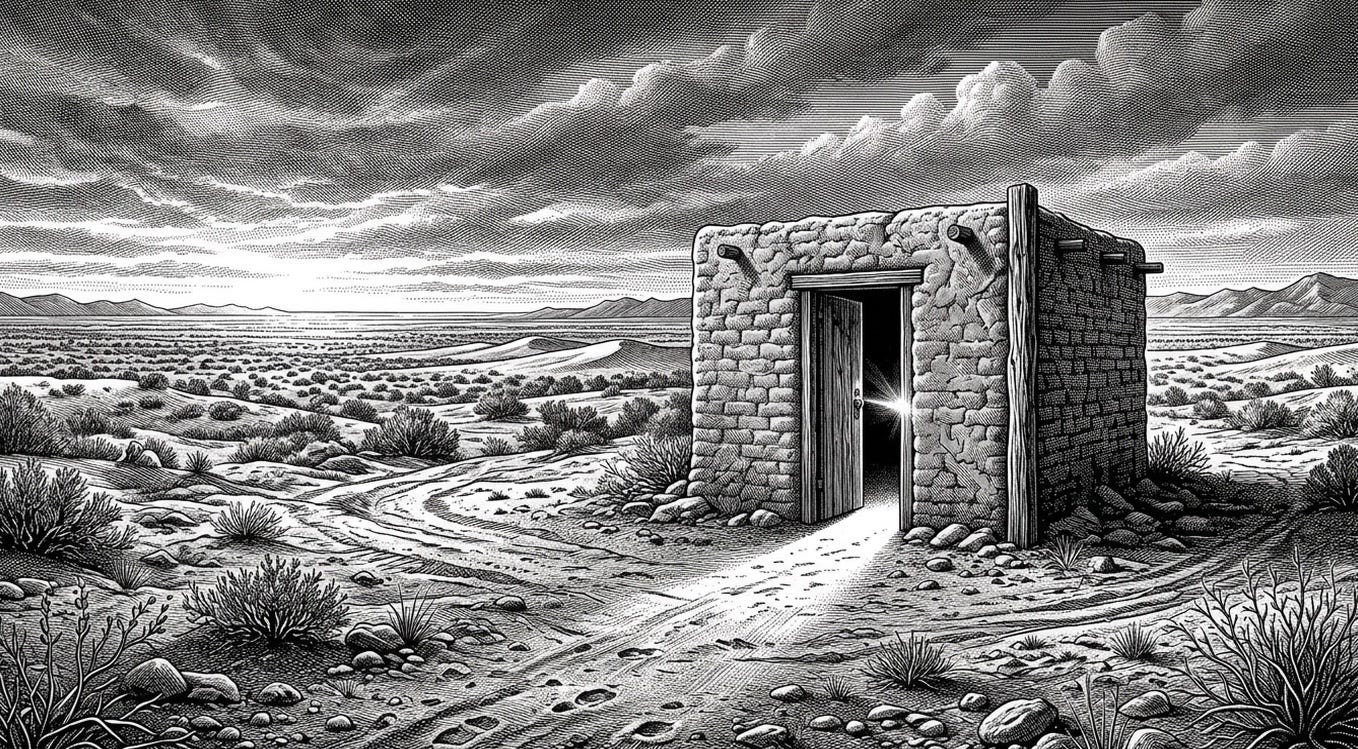
She settled on 50 acres of desert near Cuba, New Mexico. Built an adobe studio with her own hands. No phone. No electricity. No running water. The nearest person was 6 miles away.
She didn’t paint for 7 years.
Martin understood something about inputs that you’ve never examined. She wrote: “The artist must have no interruptions from himself or anyone else.” Zero. Total.
This sounds extreme. It is extreme. But what Martin did on that mesa was curation taken to its logical end. She’d spent a decade in New York absorbing: gallery politics, critical opinion, the ambient hum of other artists’ work and expectations. All of it entered her system. All of it cost something. And by 1967, she couldn’t hear her own work above the noise.
“The best things in life happen to you when you’re alone,” she said. Because solitude is the only state in which the inputs are entirely yours.
When she returned to painting in 1974, her canvases were almost empty: faint horizontal bands in pale washes, so quiet they seem to hover at the edge of perception. Critics called this later work her masterpiece.
She described the shift as learning to listen for the paintings rather than constructing them. The desert hadn’t given her new ideas. It had given her access to the ones that were already there, buried underneath a decade of noise. Every voice she’d absorbed in New York: critics, peers, curators, collectors, the ambient pressure of what art was supposed to look like in 1967. All of it had been sitting on top of her own signal, smothering it. The paintings she made after removing everything were the paintings only she could make.
She got better by removing things.
You won’t move to the desert. You have a job, a family, a mortgage, and a calendar that belongs to other people 5 days a week. Martin’s withdrawal is unrepeatable.
But her question transfers perfectly: what, exactly, are you letting in?
You’ve audited your time. You’ve optimised your calendar. You’ve tried morning routines, deep work blocks, and productivity systems with names that sound like software. All of it focused on the same question: How do I get more out?
The other question goes unasked: What am I letting in?
Everything that enters your awareness has a metabolic cost. Your brain doesn’t distinguish between information you chose and information that arrived uninvited. It processes all of it with the same energy, the same attention, the same neural resources you needed for the work that actually matters to you. The Slack thread you didn’t start. The news you didn’t search for. The 10-minute scroll that became 40 minutes and left you feeling vaguely worse than when you picked up the phone. Each one draws from the same account.
And the colleague who corners you in the kitchen to replay a frustration you’ve both already discussed 3 times: that one costs more than the rest combined, because it arrives wearing the face of connection while running the metabolism of a demand.
You know the feeling that shows up on Sunday around 4 pm. The weekend is ending, and you haven’t done anything with it, and yet you’re still tired. You sat on the couch Saturday afternoon and felt guilty about sitting on the couch. You scrolled through something forgettable and felt worse. You thought about reading that book on your nightstand and the thought itself felt like effort, so you didn’t.
There’s a name for this. Leonard Reinecke tracked 471 people through their post-work evenings and weekends. The ones most depleted by work were the ones most likely to feel guilty about resting. They classified watching TV or scrolling as procrastination, not recovery. That guilt blocked the mental distance from work that lets rest actually restore anything.
Think about that for a second. The people running on the emptiest tanks couldn’t refuel. Their guilt turned rest into another input, one more thing draining the budget they were trying to replenish. The guilt about the couch cost more than the couch itself. And that guilt was an input they never chose, never noticed, and never designed around.
The quality of everything you produce is capped by the quality of what you let in. And you’ve never designed either.
Martin’s adobe studio had a door. Behind it: silence, open desert, the specific quality of light in northern New Mexico that painters have been chasing for a century. In front of it: everything she’d walked away from.
The door was the design.
She decided what came through and what stayed outside. Every day. The curation was everything. Martin chose her inputs the way she chose her paint: deliberately, sparingly, with a clarity you’ve never once applied to the stream of information flooding your waking hours.
Your version of the door is smaller than you think. It’s the phone that stays in the drawer until 9 am. It’s the notification settings you’ve never opened. It’s the news app you open out of habit, not curiosity. It’s the podcast you listen to on the commute because silence feels uncomfortable.
Each one is an input you didn’t choose. Each one costs something. And the compound interest on those uncurated inputs is the fog you can’t explain by Friday afternoon: the sense that you’ve been busy all week and can’t point to a single thing that was yours.
You already know what your version looks like. You’ve known for months.
The hard part is that everything around you treats responsiveness as professionalism and availability as commitment. Silence is something you have to explain. You’ll close the door and feel guilty about it. And that guilt is itself an input: one more thing draining the budget, one more cost you didn’t choose, running in the background while you try to rest.
Martin spent 7 years in the desert before she could hear her own work again. You don’t need 7 years. You need 7 minutes tomorrow morning.
Before you check anything, notice the first input that arrives without your permission. Just notice it. That’s the inventory starting. That’s the door becoming visible for the first time.
How much capacity are you actually running on? The Capacity Score is a free 2-minute assessment that shows you where your system is leaking. No email required. Just one number and the clarity to know what to close first.