
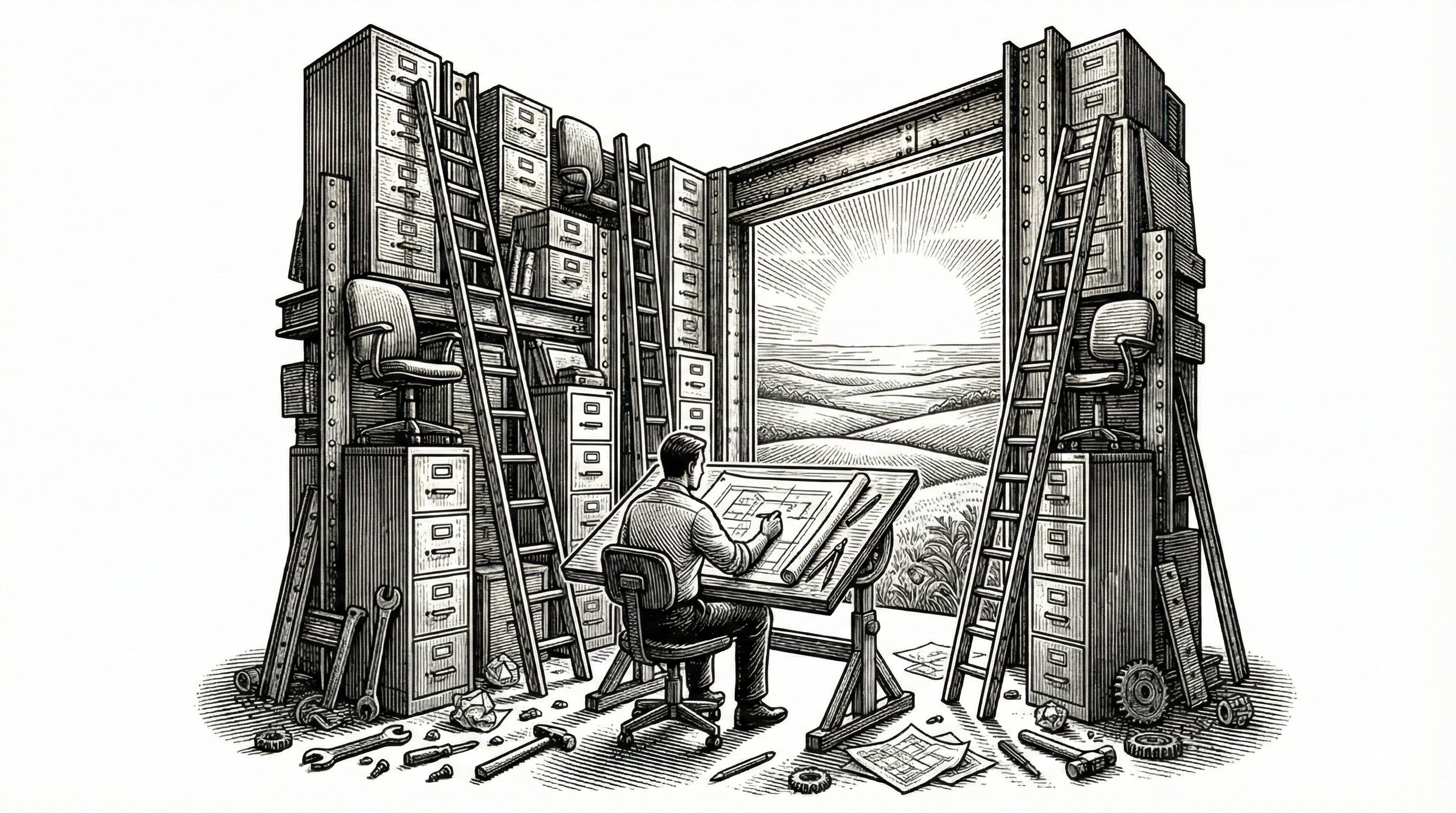
You built the cage. Only you can open the door.
Three walls keep high achievers stuck. None of them are locked.

Tuesday, 2 pm. You’re in the strategy review, the third this quarter, and the phrase “cross-functional alignment” lands the same way it did 6 months ago. You could script the next 40 minutes from memory. The slide deck will list 4 priorities, but there are really 12. Someone will ask about resourcing. No one will answer. You’ll leave with 3 action items that duplicate work already in flight.
You’re good at this. That’s not the problem. The problem is that you’ve been good at this for so long that your competence has become invisible, even to you. It just shows up, like a reflex, while the rest of you watch from somewhere further back. Quiet. Disengaged. Running a performance you stopped rehearsing years ago.
You’ve thought about leaving. Not casually. You’ve mapped it out - the savings runway, the conversations you’d need to have, the version of your LinkedIn headline that doesn’t include your current title. You’ve imagined life on the other side. And then Monday arrives. And you go back.
Again.
The pattern is more precise than it feels.
Somewhere in the last decade, your career decisions stopped being decisions and became reflexes. Research on behavioural automaticity shows this happens to everyone, but high achievers are affected the most. Ng and Feldman found that career decision-making becomes increasingly automated with experience. The same pattern recognition that makes you brilliant at your job makes you blind to alternatives. Your brain runs a race between the practised response and the novel one, and the practised response wins. Because it’s faster, not better.
Karelaia and Guillén showed that senior executives rely more heavily on fast, automatic thinking in career decisions, despite the stakes being higher than at any point in their lives. The people with the most to gain from deliberate analysis are the ones least likely to engage in it. When you sit in that strategy review, the decision to stay isn’t a decision. It’s a default. The cage isn’t locked. You’re just so used to the walls that you’ve stopped seeing the door.
And here’s the part that hurts. You know this.
You’re reading it and nodding. You’ve probably articulated some version of it yourself, in a journal, over drinks, or in one of those 11 pm conversations with your partner. You understand the dynamic intellectually. So why doesn’t understanding change anything?
Peter Gollwitzer’s research on the intention-action gap has an uncomfortable answer. For easy goals, completion rates sit around 80% regardless of planning approach. But for difficult, identity-challenging goals - the kind that require you to walk away from who you’ve been - completion drops to 22%. The problem is specificity, not willpower. “I need to change my career” is a goal intention. It lives in the abstract. What’s missing is the implementation intention: the “when X happens, I will do Y” that turns insight into action.
The irony is surgical. You build implementation plans for a living. Roadmaps, milestones, dependencies, risk matrices. You can architect a 12-month delivery programme with your eyes closed. But you haven’t built one for the most important project of your life: the transition from who you are to who you’re becoming.
There’s a third wall, and it’s the one you won’t admit to.
You won’t ask for help.
Lee’s research found that help-seeking decreases as organisational level increases, with a correlation so consistent it barely needs explaining. The higher you climb, the less likely you are to reach out. Grant and Gino studied over 10,000 professionals and found that senior leaders ask for advice 23% less often than mid-level employees - despite making more complex decisions with higher consequences.
The mechanism is identity threat. When your professional identity is built on competence - on being the person who has answers, who delivers, who doesn’t flinch - asking for help feels like a confession of fraud. The logic runs like this: if I were really as good as everyone thinks, I wouldn’t be stuck. So either I’m not that good, or I’m not really stuck. The second option is easier to believe. The identity protects itself by making the problem invisible.
Bamberger and Doveh studied 1,847 senior professionals. Those who sought help showed 28% better adaptation to career challenges. However, only 31% sought help when struggling. Nearly 7 in 10 carried the discomfort alone, protecting an image of competence at the cost of the change they needed.
You’ve built a career on self-reliance. That self-reliance is now the wall between you and the door.
Three walls. Automatic patterns you run without choosing. A gap between what you know and what you do. A refusal to ask for the help that would make the difference.
None of them are locked.
The patterns are automatic, but automatic doesn’t mean permanent. When context shifts, habits lose their grip. That refusal to ask for help is driven by identity threat. Identity threat only works when you’re guarding your competence. Use it to reach further, and the resistance breaks. And the knowing-doing gap? Gollwitzer’s data show that it closes from 22% to 72% when abstract intentions get a time and a place.
Herminia Ibarra spent decades studying professionals who made exactly the transition you’re contemplating. Her answer is concrete: the professionals who successfully changed didn’t start with clarity. Clarity was the last thing they achieved, not the first. What she calls “identity play” - testing new activities, entering new networks, trying on different versions of yourself in low-risk settings - precedes the knowing. It produces it.
70% of the successful career changers she studied discovered their new direction through experimentation, not introspection. They didn’t think their way out. They moved.
Epictetus spent years in literal chains before becoming one of the most influential philosophers in Western history. He wrote:
”First say to yourself what you would be; and then do what you have to do.”
Not: figure out who you are. Say what you would be. The verb is speculative, forward-looking. It assumes you don’t know yet. It assumes the knowing comes from the doing.
Your cage has 3 walls, and every one of them dissolves the moment you take a single, small action in a direction you haven’t tried before.
Not a resignation letter. Not a grand plan. One conversation with someone whose work you’re curious about. One afternoon on a project that has nothing to do with your current title. One honest answer to the question you’ve been avoiding: what would I build if the identity I’m protecting didn’t need protecting?
The difference between 22% and 72% is a single sentence: When I have a free Thursday afternoon, I will reach out to someone working in a field I’m curious about. One sentence, pinned to a real moment in your week. The implementation intention does what willpower can’t. It automates the new behaviour the same way the old behaviour was automated. You don’t fight the pattern. You replace it.
You built the cage. And that’s the best news you’ll hear today. Builders don’t stay trapped. They build doors.
Open yours.