
You're not mourning the job
What Seneca learned on a rocky island that most people never will

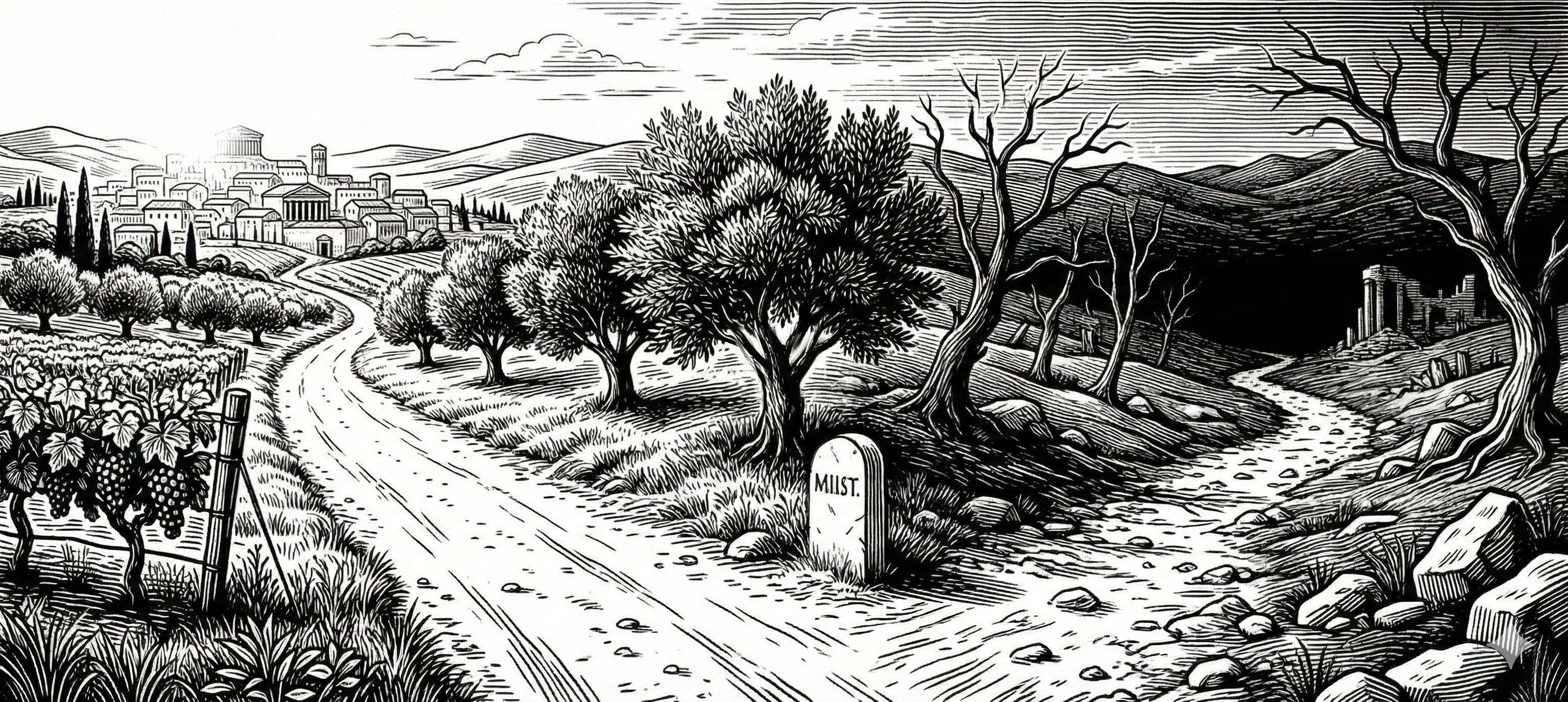
In 41 AD, Seneca was one of the most powerful men in Rome. He advised emperors. He shaped policy. He was at the centre of everything. Then he was gone. Accused of adultery (almost certainly a political maneuver), he was exiled to Corsica, a rocky island at the edge of the known world. No trial. No appeal. Just removal.
From that island, Seneca wrote a letter to his mother. Not a plea for help. Not a lament. A consolation, for her. “I have my mind,” he wrote. “I have my capacity to reason. The things that were taken from me were only ever borrowed.”
He spent 8 years on that island. He wrote some of the most enduring philosophy in Western history. When he was finally recalled to Rome, he was more influential than before.
This isn’t a story about endurance. It’s one about discovering what can’t be taken.
There is a moment, after disruption, when the mind faces a fork.
One path says: This was done to me. I am at the mercy of forces I can’t control. The story is being written by someone else.
The other path says: This happened. Now, what will I do with it?
The Stoics were obsessed with this fork. Not because they were optimists, but because they understood that the choice between these paths determines everything that follows. We go through life choosing between two effective truths: that we have the ability to change our situation, or that we’re at the mercy of the situations in which we find ourselves.
Seneca, writing from exile, chose with such force that his letter became a founding document of Western philosophy. He didn’t minimise his loss. He reframed it: “I have lost nothing that was mine.”
The role was borrowed. The influence was borrowed. What remained (his mind, his will, his capacity to choose meaning) had never been anyone else’s to take.
Marcus Aurelius extended this insight a century later: “Our actions may be impeded... but there can be no impeding our intentions or dispositions. The mind adapts and converts to its own purposes the obstacle to our acting.”
Not endures the obstacle. Converts it.
This is the Stoic reframe that has survived 2,000 years because it keeps proving true: The obstacle isn’t blocking the path. The obstacle is the path.
Here is what no one tells you about losing a role: you’re not mourning the job. You’re mourning a version of yourself.
We build identity around work. The title. The team. The years invested. These stop being descriptions and become definitions, containers for who we believe ourselves to be.
When the container is removed, we feel formless.
The philosopher Andrew Taggart calls these moments “existential openings,” crisis points that force us to grapple with deeper questions. One path into this opening is the way of loss: when things that matter are taken from us.
The disorientation is not a weakness. It is the lag between who you were yesterday and who you might become. Your nervous system is still organised around a reality that no longer exists.
But here’s the Stoic insight: the role was never you.
It was a circumstance. You brought something to it (skills, judgment, a way of seeing), and those things leave with you. Carl Jung warned: “The world will ask you who you are, and if you don’t know, the world will tell you.” A title is one answer. But it’s a borrowed answer.
The tighter we cling to an identity, the harder it becomes to grow beyond it. This isn’t a loss. It’s an edit.
The Stoics had a phrase for this: amor fati. Love of fate.
Not acceptance. Not resignation. Love.
Ryan Holiday frames it simply: “We don’t get to choose what happens to us, but we can always choose how we feel about it. If the event must occur, amor fati is the response.”
This sounds like madness until you understand what it unlocks. Seneca, writing to a friend, said: “You have passed through life without an opponent. No one can ever know what you are capable of, not even you.”
The disruption is the opponent. And the opponent reveals a capacity you didn’t know you had.
There’s a reason the Stoics keep returning across 2,000 years of history. It isn’t because life has gotten easier, but because they understood something we keep forgetting: you can’t choose your history, but you can choose the story you tell about it.
Find the lesson in it. Find the opportunity in it. Not because optimism is required, but because the alternative is surrender.
Marcus Aurelius: “True good fortune is what you make for yourself. Good fortune: good character, good intentions, and good actions.”
The Latin saying puts it more bluntly: “If there is no wind, row.”
This is the transformation. Not from victim to victor (that framing is too small). From passenger to author. From someone the story happened to, to someone who decides what the story means.
Seneca spent 8 years on that island. He didn’t wait to be rescued. He wrote. He thought. He built something that outlasted the empire that exiled him.
You aren’t on an island. But you are at a fork.
The Stoics left us a phrase for moments like this: persist and resist. Persist in your efforts. Resist giving in to distraction, discouragement, or disorder.
Albert Camus, centuries later, put it differently: “In the depths of winter, I finally learned that within me there lay an invincible summer.”
The winter is real. But so is what you carry through it. And after every rainy day, the sun shines.
Begin.