
The emotional tax you're paying without knowing it
You look calm. Your biology disagrees.

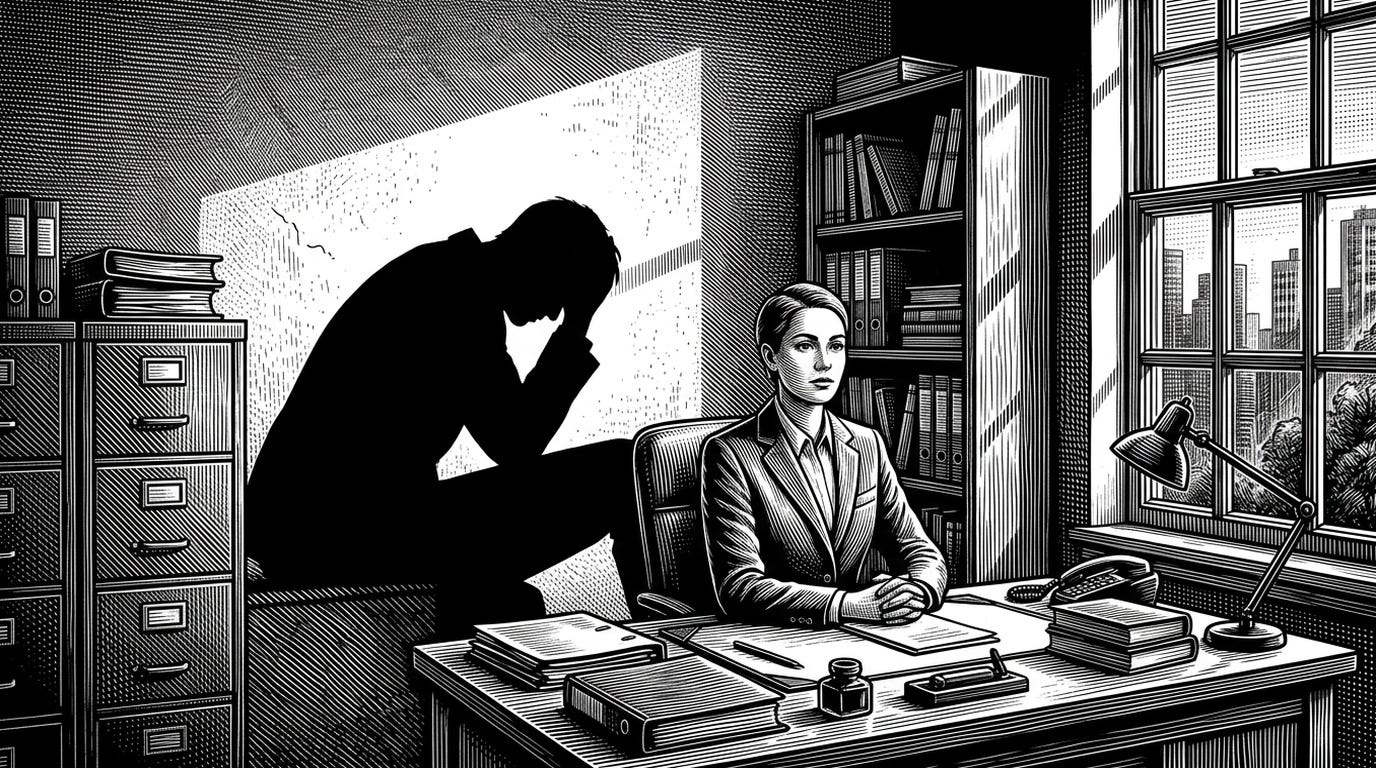
9:47 am. Your direct report is sitting opposite you, voice cracking at the edges. The project isn’t just behind schedule. The client rang their boss. Their boss rang yours. Now they’re sitting in your office, searching for something they can’t name, and you know exactly what to give them.
Your shoulders stay level. Your voice drops by half a register. You ask the right questions in the right order. By 10:15, they leave calmer than when they arrived. You do what you always do. You absorb it.
No one thanks you for this. It doesn’t show up in your performance review or your job description. But your body logged every second of it.
Arlie Hochschild called this emotional labour. The sociologist coined the term in 1983 to describe what flight attendants did when they smiled through turbulence. But it extends beyond service work. Alicia Grandey’s research distinguished two strategies people use to manage their emotions at work: surface acting and deep acting. Surface acting is what you just did. You suppressed what you felt and displayed what the situation required. Deep acting would have been genuinely shifting your internal state to match the display. You didn’t do that. You overrode it.
The distinction is important because the costs vary greatly. A meta-analysis of 95 studies found that surface acting is strongly associated with exhaustion and detachment. The effect was significant. Deep acting showed no notable link to exhaustion. Everyone manages their emotions at work. The cost depends on how they do it.
Here’s what’s really happening underneath. When you perform a surface act, your body’s stress response doesn’t get the message. James Gross found that your brain uses up cognitive resources just to keep up the facade, even while the threat response remains fully active underneath. Heart rate rises. Blood pressure goes up. You appear calm. Your biology is running a threat protocol. Gross’s finding is clear: suppressing your emotions makes you significantly worse at thinking. The calmness you display is directly taking away from the thinking power you need.
By 3 pm, you’ve repeated some version of that 9:47 am chat 4 more times. The anxious team lead. The frustrated peer who needed to vent. The skip-level manager seeking reassurance. The all-hands where you projected confidence about a quarter you’re unsure of.
Each one lasted 15 minutes. Each one left you carrying something that wasn’t yours.
You open your laptop to write a proposal that should take 90 minutes. An hour later, you’ve written 2 paragraphs. You can’t hold the thread. You blame the coffee. You blame the open-plan office. You blame your own lack of discipline.
You’re depleted. And you can’t see why because the thing that depleted you looked like competence.
Sigal Barsade spent decades studying how emotions move through organisations. Her finding: emotional contagion is automatic. When your direct report sat across from you at 9:47 am, your nervous system mirrored their distress before you consciously registered it. You mirror their expressions, match their tone, sync at a neural level - all below awareness. Brain scans confirm it: the same regions light up in you as in the person actually feeling the emotion.
Now add suppression. You absorbed the emotion through contagion. Then you suppressed any visible response because your role demanded composure. The result is contagion without resolution. The physiological arousal from resonating with someone else’s distress stays activated in your body with nowhere to go.
Your body keeps a running tab. Researchers call it allostatic load - the cumulative wear on your systems from adapting to stress that never stops. Not the acute spike of a crisis. The chronic, low-grade activation that never fully stands down. The numbers are stark: people who habitually suppress show higher inflammation markers and a measurably higher risk of heart disease. Your composure isn’t free. Your body is invoicing you in inflammation.
None of it registers as a crisis. It just accumulates.
7:30 pm. You’re home. Your partner asks how your day was.
“Fine.”
You genuinely can’t access what happened. The regulation machinery that kept you composed all day hasn’t switched off. You’re still surface acting, except now the audience is the person who doesn’t need the performance. The composure followed you home because it stopped being a strategy a decade ago. It became your operating system.
The trap is structural.
The more composed you appear at work, the more emotional load gets directed your way. A leader who visibly struggles triggers protective responses from peers and managers. A leader who absorbs everything without flinching signals infinite capacity. The organisation routes its stress toward the path of least resistance. That path is you.
There’s a name for it: the competence trap. Your capacity to regulate becomes the reason you receive more to regulate. The cycle tightens: more composure draws more load, which demands more suppression, which fuses your identity with being the strong one, which makes admitting strain feel like admitting fraud. Each loop deepens the allostatic load while making it harder to ask for the help that would release it.
Burnout is a demand-resource mismatch - too much work, not enough support. What you’re paying is different. It’s the cost of competence itself.
High performers often have strong resources relative to their demands. They still accumulate the physiological damage because the tax isn’t in the workload. It’s in the regulation. Your body doesn’t care that you handled it well. Your body cares that you’ve been suppressing 14 hours a day for 15 years.
There is a different strategy: change the meaning you assign to the triggering event rather than suppressing your response to it. It’s called cognitive reappraisal. A meta-analysis of 48 brain-scan studies found that reappraisal quiets the brain’s threat centre. Suppression does the opposite - it amplifies it. Reappraisal reduces both the display and the experience. Suppression reduces only the display while your body pays the full price underneath.
The catch: reappraisal requires awareness. Suppression requires nothing. It runs on autopilot, which is why you’ve been running it for decades without choosing it. High performers learn emotional suppression early. It becomes their signature move. They’re rewarded for it so consistently that it stops looking like a strategy and becomes a character trait. But a strategy can be changed. A trait feels permanent.
Your body has been keeping score. The afternoon fog. The inability to be present at home. The sleep that doesn’t restore. These aren’t signs of ageing or a demanding job. They’re receipts. Line items on a tab you didn’t know you were running.
You already know you can keep performing. The question is what it’s costing you.
Next week, I’ll start sharing the frameworks that changed how I design my days. Eventually, I’ll share the full system I built to redesign “the defaults” that most of us accept as normal.
But the starting point is here: you have to see what you’re paying before you can stop paying it.
Now you can see it.